Star Wars canon
"The Star Wars canon was first defined in a 1994 interview with Lucas Licensing's Sue Rostoni and Allan Kausch in issue #23 of the Star Wars Insider:
“ Gospel, or canon as we refer to it, includes the screenplays, the films, the radio dramas and the novelizations. These works spin out of George Lucas' original stories, the rest are written by other writers. However, between us, we've read everything, and much of it is taken into account in the overall continuity. The entire catalog of published works comprises a vast history — with many off-shoots, variations and tangents — like any other well-developed mythology. ”
This policy has been further refined and fleshed out over the years. The official Star Wars website has also detailed the role of canon, Expanded Universe, or "EU" sources, and how they fit into overall Star Wars continuity. In a 2001 "Ask the Jedi Council" response by Steve Sansweet (director of fan relations) and Chris Cerasi (an editor for Lucas Books at the time), it was stated that:
“ When it comes to absolute canon, the real story of Star Wars, you must turn to the films themselves — and only the films. Even novelizations are interpretations of the film, and while they are largely true to George Lucas' vision (he works quite closely with the novel authors), the method in which they are written does allow for some minor differences. The novelizations are written concurrently with the film's production, so variations in detail do creep in from time to time. Nonetheless, they should be regarded as very accurate depictions of the fictional Star Wars movies.
The further one branches away from the movies, the more interpretation and speculation come into play. LucasBooks works diligently to keep the continuing Star Wars expanded universe cohesive and uniform, but stylistically, there is always room for variation. Not all artists draw Luke Skywalker the same way. Not all writers define the character in the same fashion. The particular attributes of individual media also come into play. A comic book interpretation of an event will likely have less dialogue or different pacing than a novel version. A video game has to take an interactive approach that favors gameplay. So too must card and roleplaying games ascribe certain characteristics to characters and events in order to make them playable.
The analogy is that every piece of published Star Wars fiction is a window into the 'real' Star Wars universe. Some windows are a bit foggier than others. Some are decidedly abstract. But each contains a nugget of truth to them."
So movies are only true canon, followed by novelizations and radio plays.
Star Trek canon
"The Star Trek canon is the set of all canonical material in the Star Trek universe. It is usually defined as comprising the television series Star Trek, Star Trek: The Next Generation, Star Trek: Deep Space Nine, Star Trek: Voyager, Star Trek: Enterprise, and the first ten motion pictures in the franchise.[1] However, the official Star Trek website acknowledges that this definition is not set in stone, but that the notion of what constitutes canon in Star Trek is fluid, open to interpretation and debate.[1]
As a rule, all live action Star Trek TV series that aired are considered canon, while the cartoon Star Trek: The Animated Series and the planned but cancelled live action Star Trek: Phase II are not canon.[1] However, this policy does not make clear which version of the live action shows is the canon one. Indeed, there exist longer and shorter versions of several episodes. For example, in the 1960s during the original run of the Star Trek TV series (TOS), an hour-long show was actually 51 minutes excluding commercials, and modern DVD releases of TOS episodes are also 51 minutes long. However, as of 2007[update], an hour-long show on television is only about 42 minutes long. The canonicity of the missing nine minutes of material in modern airings of TOS episodes has never been addressed. Likewise, when special two-hour-long episodes are aired as two one-hour-long episodes in syndication, several minutes of material have to be cut to make time for the duplication of the opening and closing credits. The canonicity of this cut material has also never been addressed. Finally, the remastered TOS episodes released in 2006 present several visual differences from the episodes originally aired.[2]
To further complicate matters, it has been noted that Gene Roddenberry was something of a revisionist when it came to canon. People who worked with Roddenberry remember that he used to handle canon not on a series-by-series basis nor an episode-by-episode basis, but point by point. If he changed his mind on something, or if a fact in one episode contradicted what he considered to be a more important fact in another episode, he had no problem declaring that specific point non-canon.
See, people can easily catch us, and say "well, wait a minute, in 'Balance of Terror', they knew that the Romulans had a cloaking device, and then in 'The Enterprise Incident', they don't know anything about cloaking devices, but they're gonna steal this one because it's obviously just been developed, so how the hell do you explain that?" We can't. There are some things we just can't explain, especially when it comes from the third season. So, yes, third season is canon up to the point of contradiction, or where it's just so bad... you know, we kind of cringe when people ask us, "well, what happened in 'Plato's Stepchildren', and 'And the Children Shall Lead', and 'Spock's Brain', and so on — it's like, please, he wasn't even producing it at that point. But, generally, [canon is] the original series, not really the animated, the first movie to a certain extent, the rest of the films in certain aspects but not in all... I know that it's very difficult to understand. It literally is point by point. I sometimes do not know how he's going to answer a question when I go into his office, I really do not always know, and — and I know it better probably than anybody, what it is that Gene likes and doesn't like.[3]— Richard Arnold, 1991
Another thing that makes canon a little confusing. Gene R. himself had a habit of decanonizing things. He didn't like the way the animated series turned out, so he proclaimed that it was not canon. He also didn't like a lot of the movies. So he didn't much consider them canon either. And – okay, I'm really going to scare you with this one – after he got TNG going, he... well... he sort of decided that some of The Original Series wasn't canon either. I had a discussion with him once, where I cited a couple things that were very clearly canon in The Original Series, and he told me he didn't think that way anymore, and that he now thought of TNG as canon wherever there was conflict between the two. He admitted it was revisionist thinking, but so be it.[4]— Paula Block, 2005
Additionally, David Gerrold, in an interview about Star Trek: The Animated Series, commented on Roddenberry's parsimony and how it originally affected "canon":
Arguments about "canon" are silly. I always felt that Star Trek Animated was part of Star Trek because Gene Roddenberry accepted the paycheck for it and put his name on the credits. And DC Fontana -- and all the other writers involved -- busted their butts to make it the best Star Trek they could. But this whole business of "canon" really originated with Gene's errand boy. Gene liked giving people titles instead of raises, so the errand boy got named "archivist" and apparently it went to his head. Gene handed him the responsibility of answering all fan questions, silly or otherwise, and he apparently let that go to his head.[5]
Another factor that contributes to blur the line between canon and non-canon is the fact that some writers like to include elements from popular non-canon works into canon episodes.[6] Such is the case, for instance, of several concepts that first appeared in the Animated Series' episode "Yesteryear", including The Forge and the city of ShiKahr, and which were later included in the Enterprise three-part story that started with "The Forge".[7] However, despite the fact that elements borrowed from the Animated Series are considered canon, the series itself remains decidedly non-canon.[8]
One final issue comes from text that appears on props such as computer displays, but is not legible during the episode, except in modern HDTV broadcasts. The transcript of the text can often be obtained through behind-the-scenes pictures and interviews. This leads to the question of whether material that is in the episodes but cannot be seen clearly should be considered canon. Although there is no answer valid for all this material. In many cases this material tends to be inside jokes inserted by the production staff[9], other kinds of information, such as the biographical information seen on a computer display in "In a Mirror, Darkly", has been clearly declared not to be "hard canon".[10]
[edit] Films
As of 2009, the first ten live action Star Trek films produced to that date are considered canon.[1] However, much like for TV series, this policy fails to note which version of the films is canon. This leaves unknown the canonicity of scenes missing from the theatrical version of a film but included in home releases or director's cuts. Such is the case, for example, of a scene revealing that the character of Peter Preston was the nephew of Scotty in Star Trek II: The Wrath of Khan.[11]
Adding confusion to the issue is the fact that Roddenberry is quoted as saying he did not like the films, and "didn't much consider them canon".[4] There exists no definitive list of which films in particular Roddenberry disliked, or what elements in them he did not consider canon. For example, the reference book Star Trek Chronology states that Roddenberry considered elements of Star Trek V and Star Trek VI to be apocryphal, but it does not specify which particular elements in the films Roddenberry objected to.[12]
The canonicity of extra features found on home DVD releases, such as deleted scenes, has never been explicitly addressed.
[edit] Publications
[edit] Fiction novels
Many of the original novels published by Pocket Books are not considered part of the canon.[1] This was a guideline set early on by Gene Roddenberry, and repeated many times by people who worked with him.
And as long as Gene Roddenberry is involved in it, he is the final word on what is Star Trek. So, for us here – Ron Moore, Jeri Taylor, everybody who works on the show – Gene is the authority. And when he says that the books, and the games, and the comics and everything else, are not gospel, but are only additional Star Trek based on his Star Trek but not part of the actual Star Trek universe that he created... they're just, you know, kinda fun to keep you occupied between episodes and between movies, whatever... but he does not want that to be considered to be sources of information for writers, working on this show, he doesn't want it to be considered part of the canon by anybody working on any other projects.[3]— Richard Arnold, 1991
However, even this rule is not without its exception. Two Voyager novels written by Jeri Taylor (co-creator and then producer of Voyager), Mosaic and Pathways, were written early on in Voyager's run and detailed the background of the show's main characters.[1] These were meant to be canon, and to be used as references by the show's writers when fleshing out the characters. These two novels are sometimes named as exceptions to the "no book is canon" rule.[13] However, as some of the background information mentioned in those books was never referenced in an episode of Voyager, their status as canon is still open to debate.[1]
[edit] Novelizations
The novelizations of episodes and movies are not considered canon. This is a tradition that goes back to Gene Roddenberry himself. Roddenberry wrote a novelization of Star Trek: The Motion Picture, which included many tangents and new material that were not part of the movie, such as revealing that the woman who dies in the transporter accident was Kirk's lover.[14] While this novel filled in many gaps left in the movie, Roddenberry is quoted as saying it should not be considered canon.[15]
[edit] Reference books
A special case is made for "non-fiction" reference books such as The Star Trek Encyclopedia, Star Trek Chronology, TNG Technical Manual and DS9 Technical Manual. Unlike the novels and novelizations, these reference manuals have never been explicitly named as non-canon, and the fact that they were officially sanctioned by Paramount and given to episode writers as guides serves to give them an aura of credibility. Roddenberry himself considered it part of the "background" of Star Trek.[16] Meanwhile, Michael Okuda and Rick Sternbach, two art and technical consultants since Star Trek: The Next Generation and the authors of several of these reference books, considered their work "pretty official".[17] However, they stop short of naming the books canon, leaving the debate open.
Star Trek writer and co-producer Ronald D. Moore dismisses such official material as "speculation", and says that the writing staff did not consider it canon.[18][19] However, Viacom, the parent company of Paramount, seems to believe differently. In a series of posts to the official Star Trek website's forums, Viacom Senior Director Harry Lang left no doubt that he considers the reference books as canon.[13][20]
[edit] Other publications
The Star Trek comic books and Star Trek magazines are not considered canon.[1][3]
[edit] Other material
Nothing that takes place in Star Trek games, the Star Trek: The Experience attraction, Star Trek fan productions or Trekdom is considered canon.[1][3]
[edit] Roddenberry-approved material
Based on the amount of creative control Roddenberry exerted over the first seasons of Star Trek, some people argue that only Roddenberry-approved material should be considered canon.[21] Such an approach would eliminate from canon anything Roddenberry didn't like, as well as everything made after his death, including six movies and three TV series.
However, Roddenberry himself pre-emptively rebuked such an attitude. He had hoped that Star Trek would go on after his death.[22] As Star Trek was constantly improved by each following generation, he expected people to look back upon its humble beginnings as just that, the simple beginnings of something much bigger and better.[23] Roddenberry clearly never intended Star Trek to be limited to his work, but to include all the hopefully superior work of future generations.
[edit] Klingon language
The Klingon language was first conceived by James Doohan for the movie Star Trek: The Motion Picture, and consisted only of a few words. Later, Marc Okrand proceeded to flesh out the sparse vocabulary into a real language, complete with grammar rules and phonology, and went so far as to publish The Klingon Dictionary and to create the Klingon Language Institute.[24] Okrand's Klingon language was used to write the Klingon dialogues heard in several Star Trek movies and episodes.[25] Despite these facts, however, Ronald D. Moore stated "Whether or not [Trek writers] use the language as spelled out in Marc's dictionary is up to the individual writer," and that he "find[s] the dictionary cumbersome and usually find[s] it easier to make [the language] up phonetically."[26]"
------------------------------------------
UPDATE ON SW CANON:
"In a December 6, 2006 post, Chee contradicted his original statements regarding the canonicity of the Holocron and how it applied to the Star Wars universe:
“The only relevant official continuities are the current versions of the films alone, and the combined current version of the films along with whatever else we’ve got in the Holocron. You’re never going to know what George’s view of the universe beyond the films at any given time because it is constantly evolving.”
n August 4, 2004, when asked if the G and C-levels formed separate and independent canon, Leland Chee responded by stating that both were part of a single canon:
“There is one overall continuity.”"
A couple of years later in 2006 he confirms that there is at least one more “continuity” the “film only” continuity maintained and followed by George Lucas himself, and the “films + EU” continuity that is used for licensed products.
The fact is that “films + EU” continuity that is used for licensed products is nothing but a marketing tool to sell stuff and make money, the true canon has only 6 films and novelsation to sell stuff from and as such is limited (after all how many millenium falcon models, ewok dolls or vader masks do you really need).
The EU however opens the market up to any race, shps, tools, games, book ect ect that they can shove into it and obviously they need to give it a psudo canon status or its not “official” merchandise beause not being “official” merchandise of one sort or another means no one will buy it.
-----------------------------------------------
So, both in Star Trek and Star Wars, only on-screen evidence (including on-screen dialogue) is considered canon. Nothing else. In Star Wars, novelizations and radio plays are considered canon only as long as they don't contradict higher canon.
So levels of canonity should go (as I see it):
1) Movies
2) Novelizations
3) Cartoons, like The Clone Wars, etc.
4) Radio dramas
5) Scripts
...and on my site.
ponedjeljak, 23. kolovoza 2010.

nedjelja, 22. kolovoza 2010.
Turbolaser firepower
Imperial Star Destroyer turbolasers
Heavy turbolasers
On Mr. Anderson's site (st-v-sw.net) I found this interesting piece of txt from RotS novelization:
In the novelization of Revenge of the Sith, our introduction to the story comes with the following:
" The skies of Coruscant blaze with war.
The artificial daylight spread by the capital's orbital mirrors is sliced by intersecting flames of ion drives and punctuated by starburst explosions; contrails of debris raining into the atmosphere become tangled ribbons of cloud. The nightside sky is an infinite lattice of shining hairlines that interlock planetoids and track erratic spirals of glowing gnats. Beings watching from rooftops of Coruscant's endless cityscape can find it beautiful.
From the inside, it's different. The gnats are drive-glows of starfighters. The shining hairlines are light-scatter from turbolaser bolts powerful enough to vaporize a small town. The planetoids are capital ships."
Now, first thing we need is to obtain "small town" to blow up.
http://en.wikipedia.org/wiki/Town
If we go with US definition, "small town" might be around 500 to 2 000 people. To define area, being relatively lazy, I will use this list beacouse it already has defined values in square kilometers. By using that list, we can assume "small town" as being 10 to 40 square kilometers. Assuming circle, that gives us radius of 1.784 to 3.57 kilometers. Only small town we saw in Star Wars is Mos Eisley, which is closer to former size.
Using this calculator, we can deduce energy required to destroy such town in form of widespread destruction from air blast radius to be 0.015 to 0.12 megatons. However, that is absolutely tiny low-end estimate, and not very reasonable given what has been said in quote.
More reasonable estimate is by using fireball radius.
I will go with these values:
Fireball radius (minimum): 35 megatons
Fireball radius (airburst): 22 megatons
Fireball radius (ground-contact airburst): 10 megatons
Since we are talking about "vaporizing town", 10 megaton value for heavy turbolasers is reasonable, especially when we compare only "small town" seen in Star Wars canon - Mos Eisley - to US "small town" I used.
I decided to use this calculator to check effects. If we want to destroy New York in radius from 1700 to 3600 meters (1.0625 to 2.25 miles), it would give us 330 kilotons to 3.2 megatons.
-----------------------------------------------------------------
Before scene in which TIE bombers drop bombs on Falcon's asteroid hideout (and after scene in which Luke proclaims to Yoda "I won't fail you"), we see Star Destroyer destroying asteroids with its medium turbolasers. Asteroids are instantly vaporized, but first we have to determine their size.


Here is Imperial Star Destroyer. It is 1600 meters long - at 276 mm that gives us 5.797 meters per milimeter size ratio (values are for original picture; picture seen is automatically resized by webpage). Trench is therefore 14.5 meters tall normal or 23 meters tall at widest part. Width of TL bolts is 1/4th of trench width, or 3.625 meters. Largest asteroid vaporized is around 3 to 4 times bolt width, or 11.5 to 14.5 meters in diameter. That gives us volume of that asteroid to be 796.32 to 1596 cubic meters.
Asteroids are most probably rock, but might be silicon too. Heat capacity of silicon is 711 J(kg x K) and density is 2.329 g/cm^3. However, I can't find other values so I will use Wong's calculator. Resulting figures are 5.8 to 22.8 kilotons.
CONCLUSION: Heavy turbolasers on ISD are 0.33 to 3.2 megatons , and medium turbolasers are 5.8 to 22.8 kilotons.
I would put likely value for heavy TL as 1.8 megatons, and medium TL as 4 kilotons.
Rate of fire of heavy TL is 1 shot every 10 seconds for all heavy TL combined, and medium TL 2-3 shots per second combined. So we have average of 44.6 kilotons to 388.4 kilotons per second for combined firepower of ISD.
NOTE: Some say that turbolasers firing on asteroids were light ones. That is completely wrong - not only too high power and too small rate of fire, but also fact that these turbolasers were most likely positioned on other places of hull.
On my site
Heavy turbolasers
On Mr. Anderson's site (st-v-sw.net) I found this interesting piece of txt from RotS novelization:
In the novelization of Revenge of the Sith, our introduction to the story comes with the following:
" The skies of Coruscant blaze with war.
The artificial daylight spread by the capital's orbital mirrors is sliced by intersecting flames of ion drives and punctuated by starburst explosions; contrails of debris raining into the atmosphere become tangled ribbons of cloud. The nightside sky is an infinite lattice of shining hairlines that interlock planetoids and track erratic spirals of glowing gnats. Beings watching from rooftops of Coruscant's endless cityscape can find it beautiful.
From the inside, it's different. The gnats are drive-glows of starfighters. The shining hairlines are light-scatter from turbolaser bolts powerful enough to vaporize a small town. The planetoids are capital ships."
Now, first thing we need is to obtain "small town" to blow up.
http://en.wikipedia.org/wiki/Town
If we go with US definition, "small town" might be around 500 to 2 000 people. To define area, being relatively lazy, I will use this list beacouse it already has defined values in square kilometers. By using that list, we can assume "small town" as being 10 to 40 square kilometers. Assuming circle, that gives us radius of 1.784 to 3.57 kilometers. Only small town we saw in Star Wars is Mos Eisley, which is closer to former size.
Using this calculator, we can deduce energy required to destroy such town in form of widespread destruction from air blast radius to be 0.015 to 0.12 megatons. However, that is absolutely tiny low-end estimate, and not very reasonable given what has been said in quote.
More reasonable estimate is by using fireball radius.
I will go with these values:
Fireball radius (minimum): 35 megatons
Fireball radius (airburst): 22 megatons
Fireball radius (ground-contact airburst): 10 megatons
Since we are talking about "vaporizing town", 10 megaton value for heavy turbolasers is reasonable, especially when we compare only "small town" seen in Star Wars canon - Mos Eisley - to US "small town" I used.
I decided to use this calculator to check effects. If we want to destroy New York in radius from 1700 to 3600 meters (1.0625 to 2.25 miles), it would give us 330 kilotons to 3.2 megatons.
-----------------------------------------------------------------
Before scene in which TIE bombers drop bombs on Falcon's asteroid hideout (and after scene in which Luke proclaims to Yoda "I won't fail you"), we see Star Destroyer destroying asteroids with its medium turbolasers. Asteroids are instantly vaporized, but first we have to determine their size.


Here is Imperial Star Destroyer. It is 1600 meters long - at 276 mm that gives us 5.797 meters per milimeter size ratio (values are for original picture; picture seen is automatically resized by webpage). Trench is therefore 14.5 meters tall normal or 23 meters tall at widest part. Width of TL bolts is 1/4th of trench width, or 3.625 meters. Largest asteroid vaporized is around 3 to 4 times bolt width, or 11.5 to 14.5 meters in diameter. That gives us volume of that asteroid to be 796.32 to 1596 cubic meters.
Asteroids are most probably rock, but might be silicon too. Heat capacity of silicon is 711 J(kg x K) and density is 2.329 g/cm^3. However, I can't find other values so I will use Wong's calculator. Resulting figures are 5.8 to 22.8 kilotons.
CONCLUSION: Heavy turbolasers on ISD are 0.33 to 3.2 megatons , and medium turbolasers are 5.8 to 22.8 kilotons.
I would put likely value for heavy TL as 1.8 megatons, and medium TL as 4 kilotons.
Rate of fire of heavy TL is 1 shot every 10 seconds for all heavy TL combined, and medium TL 2-3 shots per second combined. So we have average of 44.6 kilotons to 388.4 kilotons per second for combined firepower of ISD.
NOTE: Some say that turbolasers firing on asteroids were light ones. That is completely wrong - not only too high power and too small rate of fire, but also fact that these turbolasers were most likely positioned on other places of hull.
On my site
Starship Combat Ranges
Star Trek
Ship-vs-ship
-Next Generation era
In The Next Generation episode "The Wounded" USS phoenix destroys Cardassian warship from distance of around 200 000 kilometers with display showing Phoenix' weapons range to be 225 000 km and weapons range of Cardassian warship little less than 270 000 km). Phoenix destroyed Cardassian warship with torpedoes. Later, it destroyed supply ship from range of about 170 000 km, presumably with phasers.
In "A Matter of Honor" Riker advises Klingon captain attempting to attack Enterprise-D to close to 40 000 kilometers before decloaking in order to shorten their response time (he needed BoP in transporter range for his own purposes).
In DS9 "A Call to Arms" we seem to have 10 km range for Dominion/Cardassian weapons, but that is not actually true - VFX Supervisor David Stipes (who should be fired if his work is always like that) added station in order not to confuse audience where fleet is actually going. So that example can be dismissed. Especially considering that in "The Search" we have >100 000 km weapons range for Dominion "bug".
In any case, given that short-range battles usually occur against enemies with similar fighting capabilities, it is unlikely that Federation or any other Trek power would not use it if it could help.
However, there are some reasons for shorter-range fights (in-universe reasons, not RL reason that it looks "pretty"). Shorter range also shortens enemy's response time, and makes it harder to evade beams. In "Sacrifice of Angels" and both battles of Chin'toka, we have one fleet trying to push throught other one.
Conclusion: Effective weapons range of Nebula class starship is 225 000 kilometers for torpedoes and 170 000 kilometers for phasers.
-TOS era
In TOS, long combat ranges are relatively standard when compared to TNG era. In episode "Changeling" we have probe firing on Enterprise from 90 000 km, which is "at end of their sensor range". Enterprise returns fire by using photon torpedoes, from same range. Probe is 1 meter high and 0.25 m wide (as seen after teleporting to Enterprise).
"The Ultimate Computer" shows weapons range of around 200 000 km (it also informs us that penalty for mass murder - or murder - is death - M5 attempted to committ suicide after learning that it caused death of 400 people).
Orbital bombardment
In "Skin of Evil" Enterprise-D destroys shuttlecraft lying on surface of planet from range of around 0.8 to 1 planetary diameter, or 10 to 13 thousand kilometers. Given that they were targeting small shuttlecraft, and that Nebula-class USS Phoenix demonstrated 200 000 km effective range against 400-meter long Galor-class warship, ranges of around 1 000 000 km for carpet-style planetary bombardment are possible.
Star Wars
Ship vs ship
In Return of the Jedi, we have engagement ranges of around 40 kilometers in beginning (200 km as high-end gross overestimation); later, Rebel fleet closes to "point-blank" range - Rebel cruisers basically enter into space between Imperial Star Destroyers, reducing engagement distance to few hundred, and, in some cases, few tens of meters.
Orbital bombardment
Hoth ion canon was able to hit Imperial Star Destroyer from distance which looked like 0.8 to 1 planetary diameter; assuming Hoth as Earth-sized planet (which is reasonable assumption, given that gravity on Hoth seemed to be normal), that gives us range of planetary defences versus 1.6 kilometer long capital ship as 10 to 13 thousand kilometers.
From that we can assume 4 to 6 thousand kilometer ranges for ship-vs-ship combat. (Speed of TL bolts seems to be few kilometers per second to few tens kilometers per second - that means that few hundred to few thousand km ranges are maximum against ISD-sized capital ships from SW).
UPDATE: In Revenge of Sith we have classical Napoleon-era naval tactics, with ships firing broadsides from point-blank range, as seen here:
 Distance between Invisible Hand and Republic destroyer is no more than 300 meters (Venator class is 1137 meters long). There are 6 openings in hull for heavy turbolasers, which seem to use shells for something (power pack, some form of gass/fuel/plasma etc) that are ejected after shot.

That, however, is not point - point is that these guns have extremely limited arc of fire, 30 degrees on each side (assuming guns can change horizontal orientation; we saw no proof for that and, indeed, no visible mechanism that would indicate such ability. However, it seems that guns could elevate barrels vertically; possible elevation seems to be from +30 to -30 degrees.
For comparation, main guns of WW2-era Japanese Kongo class battlecruisers and Nagato class battleships had maximum elevation of +43° for main guns (negative elevation was not so important due to most battles being fought at long range - few night battles occured at short range before advent of shiboard radars and in such situations ships could find themselves in awkward position of not being able to lower their main guns low enough to actually target enemy ships. Same issue was with sinking of Prince of Wales and Repulse - British gunners were unable to achieve low enough elevation (actually negative elevation was needed) to target Japanese planes).
Darkstar here says that guns cannot elevate barrel nor turn left or right. While he is right about guns being unable to target ships that were either left or right from direction barrel is facing, his argument about guns being unable to elevate barell is flawed... Gun does seem to have mechanism to elevate barell, but barell would have to be at zero elevation to be reloaded, similar to WW2 era guns, picture seen below.
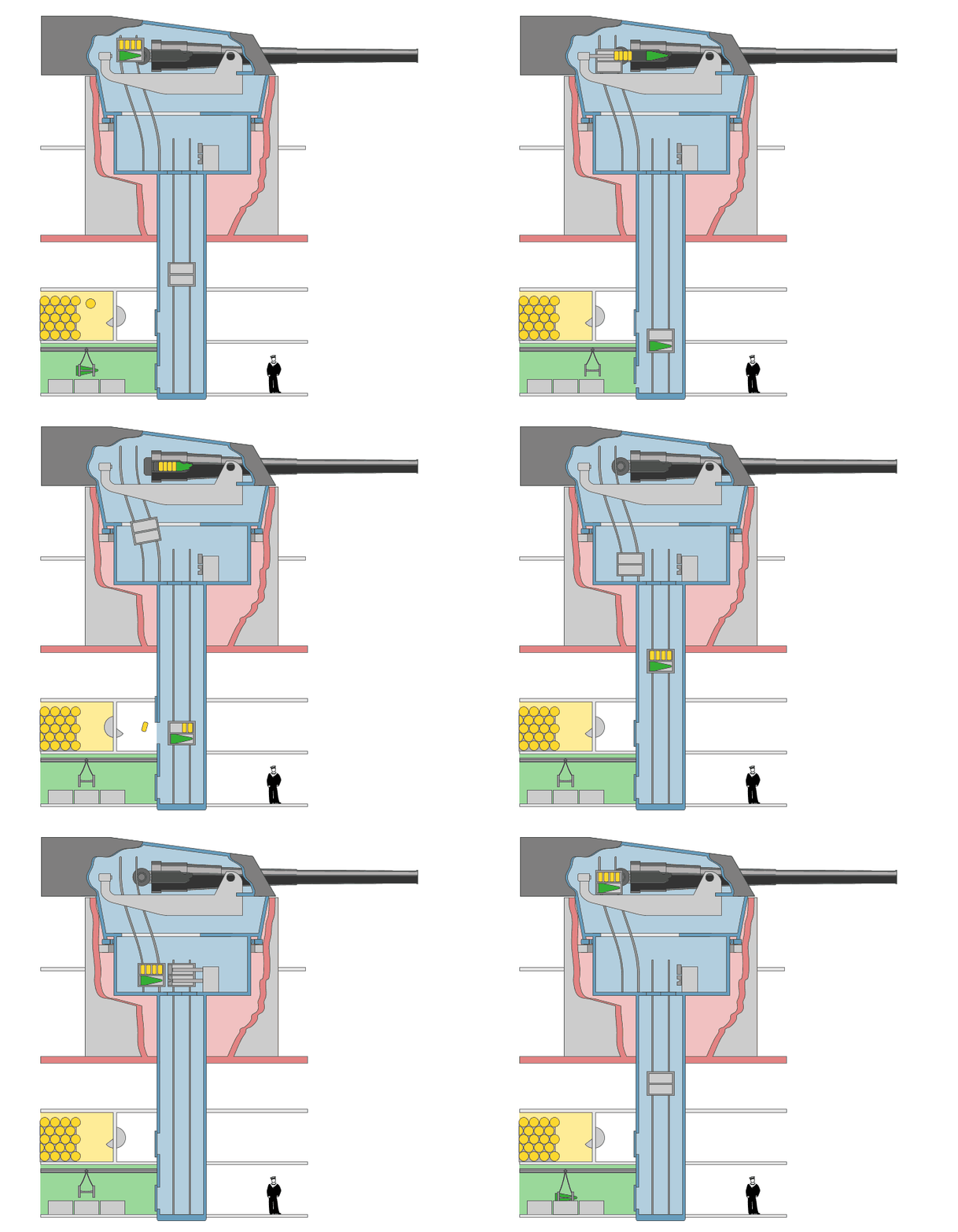
However, shell storage mechanism is wierd; but again, it could be that gun had some system that only allowed one shell to fall into loading mechanism.
UPDATE: Speed of TL bolts might be 5-10k meters per second at most. Given manouverability and speed of capital ships, actual ranges are closer to 100-500 kilometers.
UPDATE 2: It is suggested on Wong's site that TL bolts have physical projectile at their core. If that is case, then green "bolt" might just be "tracer" or "marker" to allow gunner to determine if bolt actually hit its target. Speeds of modern artillery shells reach up to 1600 m/s as per this page; given that there is no air resistence, speed of bolts as seen in movies might be possible. However, that can't explain TESB asteroid vaporization scene.
UPDATE 3: I just remembered that in ANH (both novelization and movie) Wedge Antilles commented during Rebel briefing that "not even computer could hit it" (2 m wide exhaust that was discovered to be weakness). That seems to suggest even lower effective ranges than previously calculated (at least for torpedoes).
UPDATE 4:
RotJ novelization:
"ADMIRAL Ackbar stood on the bridge in stunned disbelief, looking out the observation window at the place where, a moment before, the Rebel Star Cruiser Liberty had just been engaged in a furious long-range battle. Now, there was nothing. Only empty space, powdered with a fine dust that sparkled in the light of more distant explosions. Ackbar stared in silence."
This could mean, combined with evidence from movie itself, that maximum effective range for capital-ship battle is less than 500 km.
UPDATE 2: It seems I was wrong - mechanism I thought was for elevating barrell is actually recoil mechanism.
Ship-vs-ship
-Next Generation era
In The Next Generation episode "The Wounded" USS phoenix destroys Cardassian warship from distance of around 200 000 kilometers with display showing Phoenix' weapons range to be 225 000 km and weapons range of Cardassian warship little less than 270 000 km). Phoenix destroyed Cardassian warship with torpedoes. Later, it destroyed supply ship from range of about 170 000 km, presumably with phasers.
In "A Matter of Honor" Riker advises Klingon captain attempting to attack Enterprise-D to close to 40 000 kilometers before decloaking in order to shorten their response time (he needed BoP in transporter range for his own purposes).
In DS9 "A Call to Arms" we seem to have 10 km range for Dominion/Cardassian weapons, but that is not actually true - VFX Supervisor David Stipes (who should be fired if his work is always like that) added station in order not to confuse audience where fleet is actually going. So that example can be dismissed. Especially considering that in "The Search" we have >100 000 km weapons range for Dominion "bug".
In any case, given that short-range battles usually occur against enemies with similar fighting capabilities, it is unlikely that Federation or any other Trek power would not use it if it could help.
However, there are some reasons for shorter-range fights (in-universe reasons, not RL reason that it looks "pretty"). Shorter range also shortens enemy's response time, and makes it harder to evade beams. In "Sacrifice of Angels" and both battles of Chin'toka, we have one fleet trying to push throught other one.
Conclusion: Effective weapons range of Nebula class starship is 225 000 kilometers for torpedoes and 170 000 kilometers for phasers.
-TOS era
In TOS, long combat ranges are relatively standard when compared to TNG era. In episode "Changeling" we have probe firing on Enterprise from 90 000 km, which is "at end of their sensor range". Enterprise returns fire by using photon torpedoes, from same range. Probe is 1 meter high and 0.25 m wide (as seen after teleporting to Enterprise).
"The Ultimate Computer" shows weapons range of around 200 000 km (it also informs us that penalty for mass murder - or murder - is death - M5 attempted to committ suicide after learning that it caused death of 400 people).
Orbital bombardment
In "Skin of Evil" Enterprise-D destroys shuttlecraft lying on surface of planet from range of around 0.8 to 1 planetary diameter, or 10 to 13 thousand kilometers. Given that they were targeting small shuttlecraft, and that Nebula-class USS Phoenix demonstrated 200 000 km effective range against 400-meter long Galor-class warship, ranges of around 1 000 000 km for carpet-style planetary bombardment are possible.
Star Wars
Ship vs ship
In Return of the Jedi, we have engagement ranges of around 40 kilometers in beginning (200 km as high-end gross overestimation); later, Rebel fleet closes to "point-blank" range - Rebel cruisers basically enter into space between Imperial Star Destroyers, reducing engagement distance to few hundred, and, in some cases, few tens of meters.
Orbital bombardment
Hoth ion canon was able to hit Imperial Star Destroyer from distance which looked like 0.8 to 1 planetary diameter; assuming Hoth as Earth-sized planet (which is reasonable assumption, given that gravity on Hoth seemed to be normal), that gives us range of planetary defences versus 1.6 kilometer long capital ship as 10 to 13 thousand kilometers.
From that we can assume 4 to 6 thousand kilometer ranges for ship-vs-ship combat. (Speed of TL bolts seems to be few kilometers per second to few tens kilometers per second - that means that few hundred to few thousand km ranges are maximum against ISD-sized capital ships from SW).
UPDATE: In Revenge of Sith we have classical Napoleon-era naval tactics, with ships firing broadsides from point-blank range, as seen here:


That, however, is not point - point is that these guns have extremely limited arc of fire, 30 degrees on each side (assuming guns can change horizontal orientation; we saw no proof for that and, indeed, no visible mechanism that would indicate such ability. However, it seems that guns could elevate barrels vertically; possible elevation seems to be from +30 to -30 degrees.
For comparation, main guns of WW2-era Japanese Kongo class battlecruisers and Nagato class battleships had maximum elevation of +43° for main guns (negative elevation was not so important due to most battles being fought at long range - few night battles occured at short range before advent of shiboard radars and in such situations ships could find themselves in awkward position of not being able to lower their main guns low enough to actually target enemy ships. Same issue was with sinking of Prince of Wales and Repulse - British gunners were unable to achieve low enough elevation (actually negative elevation was needed) to target Japanese planes).
Darkstar here says that guns cannot elevate barrel nor turn left or right. While he is right about guns being unable to target ships that were either left or right from direction barrel is facing, his argument about guns being unable to elevate barell is flawed... Gun does seem to have mechanism to elevate barell, but barell would have to be at zero elevation to be reloaded, similar to WW2 era guns, picture seen below.
However, shell storage mechanism is wierd; but again, it could be that gun had some system that only allowed one shell to fall into loading mechanism.
UPDATE: Speed of TL bolts might be 5-10k meters per second at most. Given manouverability and speed of capital ships, actual ranges are closer to 100-500 kilometers.
UPDATE 2: It is suggested on Wong's site that TL bolts have physical projectile at their core. If that is case, then green "bolt" might just be "tracer" or "marker" to allow gunner to determine if bolt actually hit its target. Speeds of modern artillery shells reach up to 1600 m/s as per this page; given that there is no air resistence, speed of bolts as seen in movies might be possible. However, that can't explain TESB asteroid vaporization scene.
UPDATE 3: I just remembered that in ANH (both novelization and movie) Wedge Antilles commented during Rebel briefing that "not even computer could hit it" (2 m wide exhaust that was discovered to be weakness). That seems to suggest even lower effective ranges than previously calculated (at least for torpedoes).
UPDATE 4:
RotJ novelization:
"ADMIRAL Ackbar stood on the bridge in stunned disbelief, looking out the observation window at the place where, a moment before, the Rebel Star Cruiser Liberty had just been engaged in a furious long-range battle. Now, there was nothing. Only empty space, powdered with a fine dust that sparkled in the light of more distant explosions. Ackbar stared in silence."
This could mean, combined with evidence from movie itself, that maximum effective range for capital-ship battle is less than 500 km.
UPDATE 2: It seems I was wrong - mechanism I thought was for elevating barrell is actually recoil mechanism.
star wars ground combat (unfinished)
Ground combat
Vehicles
AT-AT walkers seem to have combat range of several kilometers, with their armor stated to be "too strong for blasters". Walkers seem to be 15-20 meters tall, probably to compensate for their line-of-view weapons, which tends to limit effective range of smaller vehicles on rough terrain. Shots from AT-AT's blaster vaporizes few cubic centimters to 1-3 cubic decimeters of snow per shot. That gives is 1 to 2 kilojoule weapons, with 2.5 kilojoules being most possible high-end estimate.
AT-ST walkers fire their blasters in bursts; individual shots barely crack trees and are weaker than AT-AT shots - my estimate is 0.5 to 1 kilojoules. Still, Chewie has no problem destroying other AT-ST's after he comandeers one; 5 shots in cabin are enought (so AT-ST armor can withstand 2.5 to 5 kJ; when one remembers that Federation phasers have output of 2.5 to 6.2 GJ per second, it is clear that even basic Federation infantry weapons are going to be stunningly effective against AT-ST walkers). Even if AT-AT walkers have 1000 times stronger armor, it will still be insufficient to stop even ordinary hand phasers - however, due to its longer range, phaser rifle will be more effective.
If we go with other possibility - assuming AT-ST armor is iron - then AT-ST shots arrive at 53 KJ.
Infantry combat
Blaster firepower
In RotJ, shot from hand blaster barely burns Leia's arm. However, in ANH, we see shots from Han's hand blaster tearing holes in concrete; holes might be around 9 centimeters in diameter and 4-9 cm deep. We do see larger explosion caused by Han's last shot, but it is not possible to estimate amount of material removed; however, it seems to be 3-5 times larger than most of remaining shots.
Density of concrete is 2400 kg/m^3; volume af material removed by ordinary shots is around 1526 - 3053 cubic centimeters; for last shot it might be 4578 to 15 265 cubic centimeters, which gives us removed mass of around 3.6624 to 7.3272 kilograms; last shot removing 10.9872 to 36.636 kilograms.
Concrete does not have melting point; when temperature is higher than 1000°C, concrete crumbles like sugar. Heat capacity of concrete is 0.880 J/(g·K).
So one blaster bolt might have energy of around 3.7 to 6.448 MJ. Given that it is stronger than seen AT-AT and AT-ST firepower, I might bump up firepower of these to 30 and 60 MJ per shot as wild guess.
Also, it is worth noting that blasters do have stun setting, as Vader instructed his crew to "set blasters on stun" when they were about to board Falcon at end of TESB.
Starship close quarters combat
In ANH we see stormtroopers boarding Rebel blockade runner. Accuracy is terrible on both sides, althoght that can be attributed to stress of CQC.
Close air support
"Anyone who has to fight, even with the most modern weapons, against an enemy in complete command of the air, fights like a savage against modern European troops, under the same handicaps and with the same chances of success. " - Erwin Rommel
If you watch Attack of the Clones, Battle of Geonosis part, you will notice that while Separatist Hailfire (sorry if I spelled wrong) droids had great success against Republic walkers, republic gunships quickly destroyed them, demonstrating importance of air superiority.
In TESB we see TIE bombers for first time, dropping bombs on surface of asteroid. Crater at which they are dropping bombs is 15-20 times Falcon's length in diameter. Falcon's length is 2 times its width, or 45 meters. Therefore, crater is 675 to 900 meters in diameter. Explosions are around 1/5th to 1/10th of crater's diameter - that gives us yield of 0.04 to 0.4 kilotons for TIE Bomber bombs.
Vehicles
AT-AT walkers seem to have combat range of several kilometers, with their armor stated to be "too strong for blasters". Walkers seem to be 15-20 meters tall, probably to compensate for their line-of-view weapons, which tends to limit effective range of smaller vehicles on rough terrain. Shots from AT-AT's blaster vaporizes few cubic centimters to 1-3 cubic decimeters of snow per shot. That gives is 1 to 2 kilojoule weapons, with 2.5 kilojoules being most possible high-end estimate.
AT-ST walkers fire their blasters in bursts; individual shots barely crack trees and are weaker than AT-AT shots - my estimate is 0.5 to 1 kilojoules. Still, Chewie has no problem destroying other AT-ST's after he comandeers one; 5 shots in cabin are enought (so AT-ST armor can withstand 2.5 to 5 kJ; when one remembers that Federation phasers have output of 2.5 to 6.2 GJ per second, it is clear that even basic Federation infantry weapons are going to be stunningly effective against AT-ST walkers). Even if AT-AT walkers have 1000 times stronger armor, it will still be insufficient to stop even ordinary hand phasers - however, due to its longer range, phaser rifle will be more effective.
If we go with other possibility - assuming AT-ST armor is iron - then AT-ST shots arrive at 53 KJ.
Infantry combat
Blaster firepower
In RotJ, shot from hand blaster barely burns Leia's arm. However, in ANH, we see shots from Han's hand blaster tearing holes in concrete; holes might be around 9 centimeters in diameter and 4-9 cm deep. We do see larger explosion caused by Han's last shot, but it is not possible to estimate amount of material removed; however, it seems to be 3-5 times larger than most of remaining shots.
Density of concrete is 2400 kg/m^3; volume af material removed by ordinary shots is around 1526 - 3053 cubic centimeters; for last shot it might be 4578 to 15 265 cubic centimeters, which gives us removed mass of around 3.6624 to 7.3272 kilograms; last shot removing 10.9872 to 36.636 kilograms.
Concrete does not have melting point; when temperature is higher than 1000°C, concrete crumbles like sugar. Heat capacity of concrete is 0.880 J/(g·K).
So one blaster bolt might have energy of around 3.7 to 6.448 MJ. Given that it is stronger than seen AT-AT and AT-ST firepower, I might bump up firepower of these to 30 and 60 MJ per shot as wild guess.
Also, it is worth noting that blasters do have stun setting, as Vader instructed his crew to "set blasters on stun" when they were about to board Falcon at end of TESB.
Starship close quarters combat
In ANH we see stormtroopers boarding Rebel blockade runner. Accuracy is terrible on both sides, althoght that can be attributed to stress of CQC.
Close air support
"Anyone who has to fight, even with the most modern weapons, against an enemy in complete command of the air, fights like a savage against modern European troops, under the same handicaps and with the same chances of success. " - Erwin Rommel
If you watch Attack of the Clones, Battle of Geonosis part, you will notice that while Separatist Hailfire (sorry if I spelled wrong) droids had great success against Republic walkers, republic gunships quickly destroyed them, demonstrating importance of air superiority.
In TESB we see TIE bombers for first time, dropping bombs on surface of asteroid. Crater at which they are dropping bombs is 15-20 times Falcon's length in diameter. Falcon's length is 2 times its width, or 45 meters. Therefore, crater is 675 to 900 meters in diameter. Explosions are around 1/5th to 1/10th of crater's diameter - that gives us yield of 0.04 to 0.4 kilotons for TIE Bomber bombs.
star trek ground combat (unfinished)
Ground combat
Infantry Equipment
Starfleet uses phaser rifles and hand phasers as primary firearms. Tricoders are used as personal sensors.
During DS9, we see more of Federation infantry equipment, like smoke grenades (seen here at 7:05 to 7:42), armor tunic (DS9 "Nor the Battle to the Strong"), and we hear about personal forcefields (althought we only see makeshift forcefield in "A Fistful of Data"), photon grenades (heard about in TNG "Legacy" and DS9 "Homefront").
Some kind of armor tunic was also used by 22nd century MACOs, as seen here.
We also see spatial charges in VOY: "Dark Frontier".
Starship close quarters combat
During TNG, ship security mainly used type-2 phasers; after Dominion War (in FC and Nemesis) we saw Security personell using Type-3 phasers, or phaser rifles, which were ergonomically better than previous generation of rifles, seen during Dominion War (which actually seemed to be short-range carbine). Both Type-3 designs had rapid-fire ability, similar to USS Defiant's pulse phased cannons. Security force on starship seems to be relatively small to moderate, maybe up to 100 personnell.
(unfinished)
Close air support
"Anyone who has to fight, even with the most modern weapons, against an enemy in complete command of the air, fights like a savage against modern European troops, under the same handicaps and with the same chances of success. " - Erwin Rommel
If you watch Attack of the Clones, Battle of Geonosis part, you will notice that while Separatist Hailfire (sorry if I spelled wrong) droids had great success against Republic walkers, republic gunships quickly destroyed them, demonstrating importance of air superiority.
While Federation des not seem to posses dedicated atmospheric craft (with exception of "hoppers", which seem to be some kind of lightly-armored transport craft), Federation Attack fighters might be very effective in close support role, due to their heavy armament and high precision.
(unfinished)
Explosives
In "A time to stand" 90 isotons of rich ultrilitium is said to be able to "take care of storage facility and everything else within 800 kilometers). Explosion completely shattered asteroid, which had volume of around 10 000 000 cubic meters. That gives us yield of 10 kilotons; given that explosive was near one side of asteroid, actual yield of explosion might be around 90 kilotons.
(unfinished)
Troop movement (interstellar)
In Waltz, we hear about Federation troop convoy, carrying over 30 000 troops, that required escort after they exited Badlands, since "without Defiant they were helpless." That seems to imply specialized transport ships.
(unfinished)
Capital ship support
In TNG episode "Arsenal of Freedom" we have away team in possibly hostile environment (which is later confirmed to be hostile) maintaining all-time communications link with starship in orbit.
(unfinished)
Infantry Equipment
Starfleet uses phaser rifles and hand phasers as primary firearms. Tricoders are used as personal sensors.
During DS9, we see more of Federation infantry equipment, like smoke grenades (seen here at 7:05 to 7:42), armor tunic (DS9 "Nor the Battle to the Strong"), and we hear about personal forcefields (althought we only see makeshift forcefield in "A Fistful of Data"), photon grenades (heard about in TNG "Legacy" and DS9 "Homefront").
Some kind of armor tunic was also used by 22nd century MACOs, as seen here.
We also see spatial charges in VOY: "Dark Frontier".
Starship close quarters combat
During TNG, ship security mainly used type-2 phasers; after Dominion War (in FC and Nemesis) we saw Security personell using Type-3 phasers, or phaser rifles, which were ergonomically better than previous generation of rifles, seen during Dominion War (which actually seemed to be short-range carbine). Both Type-3 designs had rapid-fire ability, similar to USS Defiant's pulse phased cannons. Security force on starship seems to be relatively small to moderate, maybe up to 100 personnell.
(unfinished)
Close air support
"Anyone who has to fight, even with the most modern weapons, against an enemy in complete command of the air, fights like a savage against modern European troops, under the same handicaps and with the same chances of success. " - Erwin Rommel
If you watch Attack of the Clones, Battle of Geonosis part, you will notice that while Separatist Hailfire (sorry if I spelled wrong) droids had great success against Republic walkers, republic gunships quickly destroyed them, demonstrating importance of air superiority.
While Federation des not seem to posses dedicated atmospheric craft (with exception of "hoppers", which seem to be some kind of lightly-armored transport craft), Federation Attack fighters might be very effective in close support role, due to their heavy armament and high precision.
(unfinished)
Explosives
In "A time to stand" 90 isotons of rich ultrilitium is said to be able to "take care of storage facility and everything else within 800 kilometers). Explosion completely shattered asteroid, which had volume of around 10 000 000 cubic meters. That gives us yield of 10 kilotons; given that explosive was near one side of asteroid, actual yield of explosion might be around 90 kilotons.
(unfinished)
Troop movement (interstellar)
In Waltz, we hear about Federation troop convoy, carrying over 30 000 troops, that required escort after they exited Badlands, since "without Defiant they were helpless." That seems to imply specialized transport ships.
(unfinished)
Capital ship support
In TNG episode "Arsenal of Freedom" we have away team in possibly hostile environment (which is later confirmed to be hostile) maintaining all-time communications link with starship in orbit.
(unfinished)
Planet destruction
Star Trek
Xindi superweapon
http://www.youtube.com/watch?v=A-q0hjSnbUA
As seen here, Xindi superweapon fired beam which penetrated planet's crust, reached its core and blew up planet from inside. Basically "Enterprise" version of Death Star - beam destroys planet despite not having DET power to do so.
General Order 24
General Order 24: An order to destroy all life on an entire planet. This order has been given by Captain Garth (Antos IV) and Captain Kirk (Eminiar VII). On neither occasion was the order actually fulfilled. (TOS: “A Taste of Armageddon”, “Whom Gods Destroy”)
Founder's sun-crushing bomb
Founder posing as Deep Space 9's Dr. Bashir attempted to destroy the sun using a bomb composed of trilithium, tekasite and protomatter. (DS9: "By Inferno's Light"). He was prevented from doing so by Defiant; it should be noted that bomb was relatively small, smaller than full-sized photon torpedoes used by capital ships.
Star Wars
Canon
Death Stars
Two battlestashions with ability to destroy planet. Effects of planetary destruction do not correspond to DET weapon, but rather to some sort of hyperspace-based or other technobabble weapon - that wiev is supported by ANH novelization.
Expanded Universe
Base Delta Zero
Star Wars version of General Order 24. Heavily inconsistent - in some cases turbolaser bolts merely 'put large patches of forrest on fire' while in others entire surface of planet was 'evenly cratered' and looked like surface of Moon after attack by single ISD. Given that turbolaser's firepower is in megatons, order is actually realistic.
HERE is a quote about a BDZ:-
"“Sir, what about bombardment? Is there a stage for that?”
“Blasting a planet from orbit is easy — you don’t need me to tell you how to do that. Limited orbital strikes would occur during the invasion stage. Just hope you are never given a Base Delta Zero order, lieutenant. Ah, yes, another question?”
“Sir, what’s the Base Delta Zero order?”
“Base Delta Zero is the Imperial code order to destroy all population centres and resources, including industry, natural resources and cities. All other Imperial codes are subject to change, as you well know, but this code is always the same to prevent any confusion when the order is given. Base Delta Zero is rarely issued. ….”
– “A World to Conquer” "
Sun Crusher
Small starship with special torpedoes used to destroy stars. Possibly influenced by Founder's sun-crushing bomb.
Xindi superweapon
http://www.youtube.com/watch?v=A-q0hjSnbUA
As seen here, Xindi superweapon fired beam which penetrated planet's crust, reached its core and blew up planet from inside. Basically "Enterprise" version of Death Star - beam destroys planet despite not having DET power to do so.
General Order 24
General Order 24: An order to destroy all life on an entire planet. This order has been given by Captain Garth (Antos IV) and Captain Kirk (Eminiar VII). On neither occasion was the order actually fulfilled. (TOS: “A Taste of Armageddon”, “Whom Gods Destroy”)
Founder's sun-crushing bomb
Founder posing as Deep Space 9's Dr. Bashir attempted to destroy the sun using a bomb composed of trilithium, tekasite and protomatter. (DS9: "By Inferno's Light"). He was prevented from doing so by Defiant; it should be noted that bomb was relatively small, smaller than full-sized photon torpedoes used by capital ships.
Star Wars
Canon
Death Stars
Two battlestashions with ability to destroy planet. Effects of planetary destruction do not correspond to DET weapon, but rather to some sort of hyperspace-based or other technobabble weapon - that wiev is supported by ANH novelization.
Expanded Universe
Base Delta Zero
Star Wars version of General Order 24. Heavily inconsistent - in some cases turbolaser bolts merely 'put large patches of forrest on fire' while in others entire surface of planet was 'evenly cratered' and looked like surface of Moon after attack by single ISD. Given that turbolaser's firepower is in megatons, order is actually realistic.
HERE is a quote about a BDZ:-
"“Sir, what about bombardment? Is there a stage for that?”
“Blasting a planet from orbit is easy — you don’t need me to tell you how to do that. Limited orbital strikes would occur during the invasion stage. Just hope you are never given a Base Delta Zero order, lieutenant. Ah, yes, another question?”
“Sir, what’s the Base Delta Zero order?”
“Base Delta Zero is the Imperial code order to destroy all population centres and resources, including industry, natural resources and cities. All other Imperial codes are subject to change, as you well know, but this code is always the same to prevent any confusion when the order is given. Base Delta Zero is rarely issued. ….”
– “A World to Conquer” "
Sun Crusher
Small starship with special torpedoes used to destroy stars. Possibly influenced by Founder's sun-crushing bomb.
petak, 20. kolovoza 2010.
Die is Cast firepower
In Die is Cast fleet destroys 30 % of planetary crust in single salvo (previously, we know that crust should be destroyed in 1 hour, and mantle within 5). Volume of crust could be around 1.5 x 10e10 km^3 or 1.5 x 10e19 m^3. We see 10 to 12 torpedoes and around 16 beams fired. 30% of crust equates 4.5 x 10e18 cubic meters.
Here is table of elements of crust, along with calculated volume of each element in area of crust melted in attack:
60.2 % silicium - 2.709 x 10e18 m^3
15.2 % aluminium - 6.84 x 10e17 m^3
5.5 % lime - 2.475 x 10e17 m^3
3.1 % magnesium - 1.395 x 10e17 m^3
3.8 % iron (II) oxide - 1.71 x 10e17 m^3
3 % sodium oxide - 1.35 x 10e17 m^3
2.8 % potassium oxide - 1.26 x 10e17 m^3
2.5 % iron (III) oxide - 1.125 x 10e17 m^3
1.4 % water - 6.3 x 10e16 m^3
1.2 % carbon dioxide - 5.4 x 10e16 m^3
0.7 % titanium oxide - 3.15 x 10e16 m^3
0.2 % phosphorus pentoxide - 9 x 10e15 m^3
So we now have exact volume of each of major elements of crust melted during attack. Now only thing needed to calculate exact firepower is to do 12 calculations for each element separately, then calculate sum of involved energy and calculate how much of energy is done by torpedoes and how much by energy weapons. That I will do at later time.
We know that they planned to melt both crust and mantle. Given that temperature of mantle is in range from 1400 to 3000 ° Celzius, we can assume temperature produced is at least 1400 ° C. Given that calcium oxide melts at 2572 ° C, temperatures in excess of 2600°C are possible. So temperatures produced are around 2600 ° C.
Silicium
Specific heat capacity of silicium is 1.547 J(cm^3 x K). Volume is 2.709x10e24 cm^3; that means that energy required to melt it is 1.08961398 x 10e28 J.
Aluminium
Specific heat capacity of aluminium is 2.422 J(cm^3 x K). Volume is 6.84 x 10e23 cm^3. So we have E = 4.3072848 x 10e27 J.
Magnesium
Specific heat capacity of magnesium is 1.773 J(cm^3 x K). Volume is 1.395 x 10e23 cm^3. So we have E = 6.430671 x 10e26 J .
Water
Specific heat capacity of water is 4.1796 J(cm^3 x K). Volume is 6.3 x 10e22 cm^3. So we have E = 6.8461848 x 10e26 J .
(unfinished)
I currently do not have specific heat capacities for remainder of elements, but so far we have 1.653 x 10e28 J or 3.95 exatons of firepower (3 950 000 000 gigatons). If we take torpedoes to be 5 times stronger than beams, then 1 beam has little less than 52 000 000 Gt of power and one torpedo has around 260 000 000 Gt of firepower (52 and 260 petatons).
NOTE: Some claim that visuals, which show no ejecta, no fire etc. contradict that, and that sensors were fooled by Dominion. However, such argument is nonsense. Dominion already had fleet lying in its trap, so fooling them to think attack was succeeding is actually contraproductive, since any false, over-inflated readings woud have warned Tain and his officers about Dominion plan - fleet was "manned by combat veterans", and any combat veteran would notice if destruction levels were so much out of scale. Yet, officer which read sensor report wasn't surprised at all until sensor showed no changes in lifeform readings, and only at that point they realized it was trap. And even if inflating readings was not actually contraproductive, they weren't exactly helpful - fleet was already in Dominion trap at that point. So that firepower is canon. About contradicting visuals - show did have budget after all. For other possibility look at Note 2 below.
Also, in "The Chase" one Klingon Bird of Prey can obliterate all life on a planet, to the point where no DNA would be recoverable from any of the remains. This is, to put it bluntly, impressive, however it is some sort of chain reaction. Not only that, but we know about Starfleet General Order 24 - order to destroy all life on planet. A last resort.
NOTE2: It is possible that petaton-range effective yield of weapons was not actually true yield of weapons, but rather included some form of chain reaction/NDF. Given evidence from "Chase" and visual evidence from episode, that seems most likely.
NOTE 3:
Enterprise season 3 episode 20 "the forgotten".
TUCKER: "HELL, it would take at least (he stops to think/calculate) a thousand starships like enterprise to blow up a entire planet".
Based on 1x10e29 J requirement for blowing up planet calculated by (someone) for Death Star, that quote would put firepower for each ship at 1x10e26 J or 23.9 petatons which fits with DE requirements for stated "Die is Cast" firepower.
Here is table of elements of crust, along with calculated volume of each element in area of crust melted in attack:
60.2 % silicium - 2.709 x 10e18 m^3
15.2 % aluminium - 6.84 x 10e17 m^3
5.5 % lime - 2.475 x 10e17 m^3
3.1 % magnesium - 1.395 x 10e17 m^3
3.8 % iron (II) oxide - 1.71 x 10e17 m^3
3 % sodium oxide - 1.35 x 10e17 m^3
2.8 % potassium oxide - 1.26 x 10e17 m^3
2.5 % iron (III) oxide - 1.125 x 10e17 m^3
1.4 % water - 6.3 x 10e16 m^3
1.2 % carbon dioxide - 5.4 x 10e16 m^3
0.7 % titanium oxide - 3.15 x 10e16 m^3
0.2 % phosphorus pentoxide - 9 x 10e15 m^3
So we now have exact volume of each of major elements of crust melted during attack. Now only thing needed to calculate exact firepower is to do 12 calculations for each element separately, then calculate sum of involved energy and calculate how much of energy is done by torpedoes and how much by energy weapons. That I will do at later time.
We know that they planned to melt both crust and mantle. Given that temperature of mantle is in range from 1400 to 3000 ° Celzius, we can assume temperature produced is at least 1400 ° C. Given that calcium oxide melts at 2572 ° C, temperatures in excess of 2600°C are possible. So temperatures produced are around 2600 ° C.
Silicium
Specific heat capacity of silicium is 1.547 J(cm^3 x K). Volume is 2.709x10e24 cm^3; that means that energy required to melt it is 1.08961398 x 10e28 J.
Aluminium
Specific heat capacity of aluminium is 2.422 J(cm^3 x K). Volume is 6.84 x 10e23 cm^3. So we have E = 4.3072848 x 10e27 J.
Magnesium
Specific heat capacity of magnesium is 1.773 J(cm^3 x K). Volume is 1.395 x 10e23 cm^3. So we have E = 6.430671 x 10e26 J .
Water
Specific heat capacity of water is 4.1796 J(cm^3 x K). Volume is 6.3 x 10e22 cm^3. So we have E = 6.8461848 x 10e26 J .
(unfinished)
I currently do not have specific heat capacities for remainder of elements, but so far we have 1.653 x 10e28 J or 3.95 exatons of firepower (3 950 000 000 gigatons). If we take torpedoes to be 5 times stronger than beams, then 1 beam has little less than 52 000 000 Gt of power and one torpedo has around 260 000 000 Gt of firepower (52 and 260 petatons).
NOTE: Some claim that visuals, which show no ejecta, no fire etc. contradict that, and that sensors were fooled by Dominion. However, such argument is nonsense. Dominion already had fleet lying in its trap, so fooling them to think attack was succeeding is actually contraproductive, since any false, over-inflated readings woud have warned Tain and his officers about Dominion plan - fleet was "manned by combat veterans", and any combat veteran would notice if destruction levels were so much out of scale. Yet, officer which read sensor report wasn't surprised at all until sensor showed no changes in lifeform readings, and only at that point they realized it was trap. And even if inflating readings was not actually contraproductive, they weren't exactly helpful - fleet was already in Dominion trap at that point. So that firepower is canon. About contradicting visuals - show did have budget after all. For other possibility look at Note 2 below.
Also, in "The Chase" one Klingon Bird of Prey can obliterate all life on a planet, to the point where no DNA would be recoverable from any of the remains. This is, to put it bluntly, impressive, however it is some sort of chain reaction. Not only that, but we know about Starfleet General Order 24 - order to destroy all life on planet. A last resort.
NOTE2: It is possible that petaton-range effective yield of weapons was not actually true yield of weapons, but rather included some form of chain reaction/NDF. Given evidence from "Chase" and visual evidence from episode, that seems most likely.
NOTE 3:
Enterprise season 3 episode 20 "the forgotten".
TUCKER: "HELL, it would take at least (he stops to think/calculate) a thousand starships like enterprise to blow up a entire planet".
Based on 1x10e29 J requirement for blowing up planet calculated by (someone) for Death Star, that quote would put firepower for each ship at 1x10e26 J or 23.9 petatons which fits with DE requirements for stated "Die is Cast" firepower.
četvrtak, 19. kolovoza 2010.
Federation warp drive
Warp speeds
Star trek ships have to “plot a course”; that implies that they use star charts to calculate route. It might also explain inconsistencies in speed – some parts of galaxy are more hazardous for navigation than other, plus in unexplored space they will have to use sensors to evade hazards (stars, planets etc) so that might be one of factors contributing to awfully low speeds in Star Trek : Voyager (75 years for 70 000 light years or 933 c) when compared to some other episodes. It is also possible that Voyager's usage of Bussard collectors to partially resupply during warp flight dictaded extremely low speed when compared to longer-range Galaxy class.
For example, in episode "The Chase" we have route that Professor Galen was expected to finish in few days to 6 weeks in shuttle.

According to TNG warp formula table here, warp 9 is 3.867 times faster than warp 6. That would give us warp 9 being 1 345 283.7 c in explored space and possibly under ideal conditions. That is why I tend to use Graham's idea of "warp highways" where ships travel faster than under "normal" conditions, where speeds are denoted by warp formula. Also, it is mentioned that usage of high warp "overextended" warp drive.
"Normal" warp speeds:
http://memory-alpha.org/wiki/Warp_factor
---------------------------------------------------------------------------------------------------
TNG, "Encounter at Farpoint":
At this time, top speed for the Enterprise-D is about warp 9.3. Warp 9.8 may be possible, but it may also destroy the ship.
TNG, "Where None Have Gone Before":
Maximum warp speed is about 9000c. (Data reports the distance as 2.7 million ly, and Geordi reports a 300+ year travel time.) As of the pilot, maximum warp is about 9.3.
TNG, "The Icarus Factor":
Riker claims that it would take months at high warp to get from the current location of the Enterprise to the Vega-Omicron sector, on the far side of Federation territory. Assuming the upper limit on distance is 8000 ly (per Star Trek: First Contact) and the lower limit on travel time is two months, the upper limit on speed is 48,000c. Actual speed is probably far lower.
TNG, "Q Who":
Data reports they are 7000 ly from Federation space, and it would take them 2 years and 7 months of travel to get there. This indicates that the maximum sustainable speed of the Enterprise-D is about 2700c.
TNG, "Up the Long Ladder":
The trip from the Bringloid system to NB2323 is 0.5 light-years and takes more than 18 hours at warp 5. This means that warp 5 is less than 244c.
TNG, "Bloodlines":
It would take 20 minutes to travel 300 billion km at warp 9; this would put warp 9 at 833c. This estimate is an outlier, being quite low compared to other TNG speed examples.
TNG, "Clues":
0.54 parsecs is about a day's travel at cruising speed. This would indicate a cruising speed of 644c.
TNG, "The Most Toys":
Kivas Fajo's merchant ship, with a maximum speed of warp 3, could have traveled no more than 0.102 light-years in 23 hours. This is about 39c.
VOY, "The Caretaker":
According to Janeway, at "maximum warp", Voyager's 70,000+ ly trip back to the Federation would take 75 years. This is about 1,000c. "Maximum warp" may represent the best speed they could sustain over that distance with their limited resources.
VOY, "The 37's":
According to Tom Paris, warp 9.9 is 4 billion miles per second, which is 21,473c.
VOY, "Unimatrix Zero":
Voyager travels 2 light years in 2 hours when responding to a distress call. This is about 8,766c.
VOY, "Maneuvers":
Harry Kim gives a current speed of 2 billion kilometers per second, about 6,667c.
VOY, "Scorpion":
Chakotay states that at Voyager's maximum warp, a 40 ly trip would take five days which is just under 3,000c.
VOY, "Hope and Fear":
It takes Voyager two days at high warp to travel 15 Light-years. This is approximately 2,740c.
VOY, "Equinox""
Using an exotic fuel, the USS Equinox supposedly traveled 10,000 ly in about 2 weeks, for a speed of 260,893c. It should be noted, however, that there is no actual evidence that USS Equinox achieved such speeds other than a statement from Captain Ransom, a known liar and murderer.
VOY, "Friendship One":
A 132 light-year side-trip to investigate a planet would require two months round-trip at "maximum warp". This equates to a speed of about 1584c.
VOY, "Critical Care":
When Janeway asks how quickly Paris can get Voyager to an asteroid 3 ly away, Paris replies 2 hours. This is approximately 13,149c. The "How fast can you get us there?" question suggests top speed.
ENT, "The Expanse":
The Enterprise (NX-01) took seven weeks to reach the Delphic Expanse. That is approximately 373c.
ENT, "Damage":
The Enterprise (NX-01) travelled 4 Light Years in 3 days. That is approximately 487c.
ENT, "Detained":
The Enterpise (NX-01) traveled 5.2 Light-years in 3 days. That is approximately 633c.
ENT, "Affliction":
The Enterprise (NX-01) has become capable of Warp 5.2.
TOS, "That Which Survives":
Spock predicts that the Enterprise can travel 990.7 ly in 11.33 hours at warp 8.4, for a speed of 766,503c.
TOS, "Obsession"
The Enterprise pursues an alien cloud creature to it's point of origin 1,000 light years away in the Tycho system. Kirk then notes that they must make a rendezvous with the starship Yorktown, coming back the 1,000 ly to make the rendezvous in 48 hours. Thus one day to get to the Tycho system and one day to come back for a speed of 365,000c
TOS, "The Squire of Gothos"
The Enterprise is 900 light-years from Earth. While this is not a specific speed versus distance quote, it does show that the Enterprise can travel in one week out into unexplored territory across nearly a thousand light years, then the next week be somewhere completely different for the events of "Arena".
TOS, "The Cage/The Menagerie"
Pike attempting to communicate with his Talosian captors "My name is Christopher Pike, commander of the space vehicle Enterprise from a stellar group at the other end of this galaxy". This implies travel on a galactic scale, and would require speed and knowledge unlike anything seen in all of Trek. Some have taken it to mean not the literal other opposite side of the Milky Way galaxy from where Earth would be located, but something much closer.
TOS, "Where No Man Has Gone Before"
The Enterprise seems capable of routine travel to the very literal edges of the galaxy where they are turned back by a mysterious energy barrier. This will not be the only time the ship travels this far and beyond in TOS; "By Any Other Name" and "Is There In Truth No Beauty?". Even if the ship is somehow heading "up" or "down" straight out of the Galaxy though the shortest distance possible, not going to the outer edges of the spiral arm disk, it still means the Enterprise has to traverse across thousands of light years, and all in a very short span of time.
TOS, "Bread and Circuses"
The Enterprise travels across one-sixteenth of a parsec in "seconds". This would equate to a speed of approximately 215,000c, assuming it took a full 30 seconds to get to the system, never mind the specific planet there.
Trekkies have difficulty explaining why Federation starships of the 24th century would be substantially slower than Federation starships of the 23rd century. Their response is that Warsies cherrypick modern Trek for the lowest showings, ignoring higher examples, such as the following:
TNG, "The Chase"
Picard's old professor Galen marks out a path on a map of the Milky Way galaxy that must be followed in order to put together an ancient puzzle. The line Galen traces subtends an impressive 40,000 lys. Galen then notes that with a shuttle or transport, the trip will require months to complete, but if he had access to a starship, then it would only be a matter of weeks. The minimum speed a starship would require to complete the journey as shown would require an average speed of 1 million c.
TNG, "The Best of Both Worlds, Part I and II"
The E-D chases the Borg cube back to Earth over the course of 6 days from the edges of Federation territory. Assuming the nearest edge of Federation space was just 1,000 ly away from Earth, it would require the E-D to maintain a speed of nearly 61,000 c.
DS9, "Valiant"
The cadets tell how the original mission of the Defiant-class USS Valiant was to circumnavigate the 8,000 ly Federation in 90 days. Assuming by that they ment the ship was to go straight out 8,000 lys and then come back to Earth with no stops along the way, then the ship would need a speed of 64,888c.
However, if "circumnavigate" means "circumvent", we have 2 x 4000 ly x pi or 25 000 light years in 90 days. That is 102 000 c.
-----------------------------------------------------------------------------------------------------------
Warp manouvering
Janeway: "Tom, what's the first thing they teach you about maneuvering at warp?"
Tom: "'Faster than light, no left or right.' When possible, maintain a linear trajectory. Course corrections could fracture the hull."
Janeway: "Exactly. We'd have to drop to impulse every time we made a course change."
That basically throws any possibility of radical warp manouvers out through window (it also explains why Dominion fleet was able to simply wait for Federation fleet to come to them - "hold a roadblock", as I put it on Factpile. Federation fleet did not want to lose time by taking longer route, and Dominion fleet blocked route they were going - after all, Dominion has sensors capable of detecting ships from way longer range than Federation can).
There are some examples of warp manouvering, as seen here. However, all these examples involve one to two ships at most; performing warp manouvers with entire fleet will be extremely difficult at best, especially if fleet has large number of older ships. Also, in TOS episode "The Ultimate Computer" we have clear and relatively rapid warp manouvering at warp 4.
On my site.
Star trek ships have to “plot a course”; that implies that they use star charts to calculate route. It might also explain inconsistencies in speed – some parts of galaxy are more hazardous for navigation than other, plus in unexplored space they will have to use sensors to evade hazards (stars, planets etc) so that might be one of factors contributing to awfully low speeds in Star Trek : Voyager (75 years for 70 000 light years or 933 c) when compared to some other episodes. It is also possible that Voyager's usage of Bussard collectors to partially resupply during warp flight dictaded extremely low speed when compared to longer-range Galaxy class.
For example, in episode "The Chase" we have route that Professor Galen was expected to finish in few days to 6 weeks in shuttle.

Our galaxy is light years in diameter, and route shown is approximately equal to 4/5ths of its radius, or 40 000 light years. Most TNG shuttles are able to achieve warp 6, so we have warp 6 being 347 857 c in explored space.
According to TNG warp formula table here, warp 9 is 3.867 times faster than warp 6. That would give us warp 9 being 1 345 283.7 c in explored space and possibly under ideal conditions. That is why I tend to use Graham's idea of "warp highways" where ships travel faster than under "normal" conditions, where speeds are denoted by warp formula. Also, it is mentioned that usage of high warp "overextended" warp drive.
"Normal" warp speeds:
http://memory-alpha.org/wiki/Warp_factor
---------------------------------------------------------------------------------------------------
TNG, "Encounter at Farpoint":
At this time, top speed for the Enterprise-D is about warp 9.3. Warp 9.8 may be possible, but it may also destroy the ship.
TNG, "Where None Have Gone Before":
Maximum warp speed is about 9000c. (Data reports the distance as 2.7 million ly, and Geordi reports a 300+ year travel time.) As of the pilot, maximum warp is about 9.3.
TNG, "The Icarus Factor":
Riker claims that it would take months at high warp to get from the current location of the Enterprise to the Vega-Omicron sector, on the far side of Federation territory. Assuming the upper limit on distance is 8000 ly (per Star Trek: First Contact) and the lower limit on travel time is two months, the upper limit on speed is 48,000c. Actual speed is probably far lower.
TNG, "Q Who":
Data reports they are 7000 ly from Federation space, and it would take them 2 years and 7 months of travel to get there. This indicates that the maximum sustainable speed of the Enterprise-D is about 2700c.
TNG, "Up the Long Ladder":
The trip from the Bringloid system to NB2323 is 0.5 light-years and takes more than 18 hours at warp 5. This means that warp 5 is less than 244c.
TNG, "Bloodlines":
It would take 20 minutes to travel 300 billion km at warp 9; this would put warp 9 at 833c. This estimate is an outlier, being quite low compared to other TNG speed examples.
TNG, "Clues":
0.54 parsecs is about a day's travel at cruising speed. This would indicate a cruising speed of 644c.
TNG, "The Most Toys":
Kivas Fajo's merchant ship, with a maximum speed of warp 3, could have traveled no more than 0.102 light-years in 23 hours. This is about 39c.
VOY, "The Caretaker":
According to Janeway, at "maximum warp", Voyager's 70,000+ ly trip back to the Federation would take 75 years. This is about 1,000c. "Maximum warp" may represent the best speed they could sustain over that distance with their limited resources.
VOY, "The 37's":
According to Tom Paris, warp 9.9 is 4 billion miles per second, which is 21,473c.
VOY, "Unimatrix Zero":
Voyager travels 2 light years in 2 hours when responding to a distress call. This is about 8,766c.
VOY, "Maneuvers":
Harry Kim gives a current speed of 2 billion kilometers per second, about 6,667c.
VOY, "Scorpion":
Chakotay states that at Voyager's maximum warp, a 40 ly trip would take five days which is just under 3,000c.
VOY, "Hope and Fear":
It takes Voyager two days at high warp to travel 15 Light-years. This is approximately 2,740c.
VOY, "Equinox""
Using an exotic fuel, the USS Equinox supposedly traveled 10,000 ly in about 2 weeks, for a speed of 260,893c. It should be noted, however, that there is no actual evidence that USS Equinox achieved such speeds other than a statement from Captain Ransom, a known liar and murderer.
VOY, "Friendship One":
A 132 light-year side-trip to investigate a planet would require two months round-trip at "maximum warp". This equates to a speed of about 1584c.
VOY, "Critical Care":
When Janeway asks how quickly Paris can get Voyager to an asteroid 3 ly away, Paris replies 2 hours. This is approximately 13,149c. The "How fast can you get us there?" question suggests top speed.
ENT, "The Expanse":
The Enterprise (NX-01) took seven weeks to reach the Delphic Expanse. That is approximately 373c.
ENT, "Damage":
The Enterprise (NX-01) travelled 4 Light Years in 3 days. That is approximately 487c.
ENT, "Detained":
The Enterpise (NX-01) traveled 5.2 Light-years in 3 days. That is approximately 633c.
ENT, "Affliction":
The Enterprise (NX-01) has become capable of Warp 5.2.
TOS, "That Which Survives":
Spock predicts that the Enterprise can travel 990.7 ly in 11.33 hours at warp 8.4, for a speed of 766,503c.
TOS, "Obsession"
The Enterprise pursues an alien cloud creature to it's point of origin 1,000 light years away in the Tycho system. Kirk then notes that they must make a rendezvous with the starship Yorktown, coming back the 1,000 ly to make the rendezvous in 48 hours. Thus one day to get to the Tycho system and one day to come back for a speed of 365,000c
TOS, "The Squire of Gothos"
The Enterprise is 900 light-years from Earth. While this is not a specific speed versus distance quote, it does show that the Enterprise can travel in one week out into unexplored territory across nearly a thousand light years, then the next week be somewhere completely different for the events of "Arena".
TOS, "The Cage/The Menagerie"
Pike attempting to communicate with his Talosian captors "My name is Christopher Pike, commander of the space vehicle Enterprise from a stellar group at the other end of this galaxy". This implies travel on a galactic scale, and would require speed and knowledge unlike anything seen in all of Trek. Some have taken it to mean not the literal other opposite side of the Milky Way galaxy from where Earth would be located, but something much closer.
TOS, "Where No Man Has Gone Before"
The Enterprise seems capable of routine travel to the very literal edges of the galaxy where they are turned back by a mysterious energy barrier. This will not be the only time the ship travels this far and beyond in TOS; "By Any Other Name" and "Is There In Truth No Beauty?". Even if the ship is somehow heading "up" or "down" straight out of the Galaxy though the shortest distance possible, not going to the outer edges of the spiral arm disk, it still means the Enterprise has to traverse across thousands of light years, and all in a very short span of time.
TOS, "Bread and Circuses"
The Enterprise travels across one-sixteenth of a parsec in "seconds". This would equate to a speed of approximately 215,000c, assuming it took a full 30 seconds to get to the system, never mind the specific planet there.
Trekkies have difficulty explaining why Federation starships of the 24th century would be substantially slower than Federation starships of the 23rd century. Their response is that Warsies cherrypick modern Trek for the lowest showings, ignoring higher examples, such as the following:
TNG, "The Chase"
Picard's old professor Galen marks out a path on a map of the Milky Way galaxy that must be followed in order to put together an ancient puzzle. The line Galen traces subtends an impressive 40,000 lys. Galen then notes that with a shuttle or transport, the trip will require months to complete, but if he had access to a starship, then it would only be a matter of weeks. The minimum speed a starship would require to complete the journey as shown would require an average speed of 1 million c.
TNG, "The Best of Both Worlds, Part I and II"
The E-D chases the Borg cube back to Earth over the course of 6 days from the edges of Federation territory. Assuming the nearest edge of Federation space was just 1,000 ly away from Earth, it would require the E-D to maintain a speed of nearly 61,000 c.
DS9, "Valiant"
The cadets tell how the original mission of the Defiant-class USS Valiant was to circumnavigate the 8,000 ly Federation in 90 days. Assuming by that they ment the ship was to go straight out 8,000 lys and then come back to Earth with no stops along the way, then the ship would need a speed of 64,888c.
However, if "circumnavigate" means "circumvent", we have 2 x 4000 ly x pi or 25 000 light years in 90 days. That is 102 000 c.
-----------------------------------------------------------------------------------------------------------
Warp manouvering
Janeway: "Tom, what's the first thing they teach you about maneuvering at warp?"
Tom: "'Faster than light, no left or right.' When possible, maintain a linear trajectory. Course corrections could fracture the hull."
Janeway: "Exactly. We'd have to drop to impulse every time we made a course change."
That basically throws any possibility of radical warp manouvers out through window (it also explains why Dominion fleet was able to simply wait for Federation fleet to come to them - "hold a roadblock", as I put it on Factpile. Federation fleet did not want to lose time by taking longer route, and Dominion fleet blocked route they were going - after all, Dominion has sensors capable of detecting ships from way longer range than Federation can).
There are some examples of warp manouvering, as seen here. However, all these examples involve one to two ships at most; performing warp manouvers with entire fleet will be extremely difficult at best, especially if fleet has large number of older ships. Also, in TOS episode "The Ultimate Computer" we have clear and relatively rapid warp manouvering at warp 4.
On my site.
utorak, 17. kolovoza 2010.
Shipboard phasers
"Masks"
In this episode we see Enterprise-D melting comet.


To make our comet boil, we need to do following things:
1) Raise temperature of ice to melting point (0°C or 273 K)
2) Melt ice ( E = 333.55 kJ/kg or 333 550 J/kg)
3) Raise temperature of water to boiling point (373 K)
4) Make water boil (2257 kJ/kg or 2 257 000 J/kg)
Heat capacity:
ice at -10°C : 1.938 J/(cm^3 x K)
water at 25 ° C : 1.938 J/(cm^3 x K)
water at 100 ° C : 4.2160 J/(cm^3 x K)
After ice/water have reached sufficient temperature to melt/boil (0°C for melting, 100°C for boiling), you need to add additional energy for melting/boiling to actually occur. To melt ice, that energy is 333 550 J/kg; to boil water, you need 2 257 000 J/kg. Density of water at 0°C is 999.8395 kg/m^3; density at 100°C is 958.4 kg/m^3.
Mass of comet is around 3.868474 x 10e13 kg.
So for step one we need 1.1394x10e19 J.
Step two requires 1.29x10e19 J.
Step three requires 8.17836 x 10e18 J.
Step four requires 8.73 x 10e19 J.
So energy required in total is 1.197838 x 10e20 J. Gigaton is 4.184 x 10e18 J. So total energy delivered is around 28.629 Gt over course of 10 seconds, on 10% power. Actually, it would be more like 25 Gt due to object inside, or 2.5 Gt per second at 10% power. NDF, if applied, might lower actual DET value somwhat (to around 0.25 Gt per second at 10% power).
Other examples
In "Who Watches the Watchers" Riker considered a 4.2 Gigawatt generator sufficient to power "a small phaser bank". In "The Mind's Eye" Data says a Type 3 phaser rifle was using energy at a rate of "one point oh five megajoules per second". In "A Matter of Time" Geordi cautions that it will be difficult to control the ship's phasers to within 0.06 Terawatts (60 Gigawatts). That would seem to confirm that shipboard phasers are in Terawatt range at least, possibly even in Petawatt range given that we're talking about 24th century.
Also, here we have very interesting theory about phaser output, by Graham Kennedy.
"So 5 GW hand phasers are reasonable, and even 73 GW is not impossible. "
This is my conclusion for Type-2 hand phasers output. If we reduce that to 50 MW, Type 10 would come as 5 PW. If my conclusion is correct, then Type-10 phaser would have output of 500 PW, or 0.119 Gt per second. If my Masks calculations are good, output would rise to 1.046 x 10e20 W or 10.46 exawatts.
During TNG, Enterprise D drilled hole 50 meters wide at minimum and 2800 km deep in 14 seconds. Phasers were specially modified to prevent tecton instabilities and earthquakes which would be caused by normal phaser beam. That is 5.5 billion cubic meters of rock melted. Granite has density of 2.7 g/cm^3 average. That gives us 1.48 x 10e16 grams of granite melted. Granite has heat capacity of 0.79 (kJ/kg K). Granite melts at 1215 to 1260 ° C. So delta t=1200 K. Energy is 1.4 x 10e19 J over 14 seconds or 1 x 10e18 J per second. That is 2.39 gigatons per second.
Conclusion: Phasers are 2.39 Gt per second minimum
Also, term phaser originally comes from photon maser, which suggests that phaser is primarly particle weapon using photons (hand phasers were described as particle weapons on several occasions), with NDF/chain reaction as optional extra (althought we don't know that for certain).
Generations incident
D 12 was able to destroy 1 058 968 052 to 2 117 936 103 cubic centimeters of Enterprise-D's hull with each shot, depending if only outer hull was damaged or inner too. Actual value is between these two. I will take that shots heated hull 15 000 K. So we have 4.76 x 10e18 to 1.143 x 10e19 joules per shot for our outdated D-12. That is 1.138 to 2.73 gigatons per shot.


Note: Special thanks to Starfleet Jedi forum for providing screenshot showing size of comet in relation to size of object buried iside (episode Masks).
22nd century phaser cannons
Designed as a starship-based version of the hand-held phase pistol, the phase cannon was rated for a maximum power output of 500 gigajoules (given occasional confusion of basic physical terms by Star Trek writers - which only worsened over time - it is quite possible that actual output is 500 GW, and not 500 GJ - for that, however, we have no confirmation. Still, given that shots from these cannons generally last for about 1 second, it is essentially same).
UPDATE: Output of warp core is calculated at 5.84x10e24 W. If phasers use 10% of core output, then we are talking about 5.84x10e23 W or 139.579 teratons per second as high end.
On other note, 4.2 GW is enough to power small phaser bank, presumably consisting of single emitter. I will take that to be shuttlepod emitter. Now, GCS emitters are certainly larger than those on shuttlepod, and I will take them as being 8 times more powerful.
Emitters are in two rows. 12.82 meters long segment has 9 emitters in one row.
Array is incomplete ellipse, with long axis being 321 and short one 214 meters. Array itself is 7/8 of length of ellipse, which gives array length of 749.875 meters. So total count of emitters is 526 in one row, and 1052 total. So total energy output of GCS main array is 35 347 GW high and 4 418 GW low end (low end is taking GCS emitters as being equal in power to those on shuttlepod - GCS certainly does not use "small" emitters, but it is useful as lower end).
Galaxy class hull
http://www.youtube.com/watch?v=fyNm8EWM5K0&NR=1
Here we se that hull thickness of Enterprise-D is 70 centimeters. Hull of galaxy class starship is made of tritanium, and was shown here to be able to absorb rather impressive damage.
Both from Q Who and Best of Both Worlds, Part II it is clear that Enterprise-D has inner and outer hull. That means that, while total hull thickness might be 70 centimeters, it is actually lower due to space between inner and outer hull plates, which is around 6 times thickness of single hull plate. So Galaxy class has double hull, with each hull being 12 centimeters thick.
"Hand phaser can put 100 megajoules of disintegration energy in a beam a centimeter wide, and yet can't even melt - let alone disintegrate - a tritanium plate a few centimeters thick? If 100 MJ/cm^2 were sufficient to punch a hole through several centimeters of tritanium, disintegrating several hundred square meters of tritanium cladding several tens of centimeters thick would require close to a gigaton." - from Starfleet Jedi
So it seems possible that GCS hull might be able to withstand kiloton- to megaton- level weaponry. Enterprise-D saucer was able to survive crash-landing without any apparent damage to hull - althought damage to inner parts was heavy, outer hull "shell" seemed intact.
That is reinforced by TNG episode "Wounded" - in that episode, both Galaxy-class USS Enterprise-D and Nebula class USS Phoenix were able to withstand hits from Cardassian warship's main beam weapons as result of unshielded attack - Enterprise D was hit while its shields were still down (with only damage reports being "minor damage to secondary hull" and "starboard power coupling down" reports by Worf and LaForge), and Phoenix was hit with its shields disabled. Also, explosion caused by warp core breach of "bug" that collided with USS Odissey produced relatively minor damage to secondary hull - however, due to sensitivity of that area, ship was destroyed by warp core breach. USS Galaxy, lead ship of class, withstood significant pounding in First battle of Chin'toka.
Analyzing Arsenal of Freedom
Hand phasers have 5 to 12 GW power output, with 73 GW high end. In "Arsenal of Freedom" Tasha Yar states that Federation weapons cannot melt centimeter thick plate of tritanium. If we take that hand phaser can melt 5 cm^3 of tritanium per second (tritanium is able to withstand 12 000 ° C without showing any signs of melting) then heat capacity of tritanium is around 300 000 J/(cm^3 x K) to 720 000 J/(cm^3 x K).
Generations incident
D 12 was able to destroy 1 058 968 052 to 2 117 936 103 cubic centimeters of Enterprise-D's hull with each shot, depending if only outer hull was damaged or inner too. Actual value is between these two. I will take that shots heated hull 15 000 K. So we have 4.76 x 10e18 to 1.143 x 10e19 joules per shot for our outdated D-12. That is 1.138 to 2.73 gigatons per shot.
Here we se that hull thickness of Enterprise-D is 70 centimeters. Hull of galaxy class starship is made of tritanium, and was shown here to be able to absorb rather impressive damage.
Both from Q Who and Best of Both Worlds, Part II it is clear that Enterprise-D has inner and outer hull. That means that, while total hull thickness might be 70 centimeters, it is actually lower due to space between inner and outer hull plates, which is around 6 times thickness of single hull plate. So Galaxy class has double hull, with each hull being 12 centimeters thick.
"Hand phaser can put 100 megajoules of disintegration energy in a beam a centimeter wide, and yet can't even melt - let alone disintegrate - a tritanium plate a few centimeters thick? If 100 MJ/cm^2 were sufficient to punch a hole through several centimeters of tritanium, disintegrating several hundred square meters of tritanium cladding several tens of centimeters thick would require close to a gigaton." - from Starfleet Jedi
So it seems possible that GCS hull might be able to withstand kiloton- to megaton- level weaponry. Enterprise-D saucer was able to survive crash-landing without any apparent damage to hull - althought damage to inner parts was heavy, outer hull "shell" seemed intact.
That is reinforced by TNG episode "Wounded" - in that episode, both Galaxy-class USS Enterprise-D and Nebula class USS Phoenix were able to withstand hits from Cardassian warship's main beam weapons as result of unshielded attack - Enterprise D was hit while its shields were still down (with only damage reports being "minor damage to secondary hull" and "starboard power coupling down" reports by Worf and LaForge), and Phoenix was hit with its shields disabled. Also, explosion caused by warp core breach of "bug" that collided with USS Odissey produced relatively minor damage to secondary hull - however, due to sensitivity of that area, ship was destroyed by warp core breach. USS Galaxy, lead ship of class, withstood significant pounding in First battle of Chin'toka.
Analyzing Arsenal of Freedom
Hand phasers have 5 to 12 GW power output, with 73 GW high end. In "Arsenal of Freedom" Tasha Yar states that Federation weapons cannot melt centimeter thick plate of tritanium. If we take that hand phaser can melt 5 cm^3 of tritanium per second (tritanium is able to withstand 12 000 ° C without showing any signs of melting) then heat capacity of tritanium is around 300 000 J/(cm^3 x K) to 720 000 J/(cm^3 x K).
Generations incident
D 12 was able to destroy 1 058 968 052 to 2 117 936 103 cubic centimeters of Enterprise-D's hull with each shot, depending if only outer hull was damaged or inner too. Actual value is between these two. I will take that shots heated hull 15 000 K. So we have 4.76 x 10e18 to 1.143 x 10e19 joules per shot for our outdated D-12. That is 1.138 to 2.73 gigatons per shot.
nedjelja, 15. kolovoza 2010.
Death Star sizes
Death Star I

Death star is 135 mm high and 141 mm wide in this shot. Equatorial trench is 0.9 to 1 mm high.
Now we have following shots:


Falcon is around 22.5 meters width. That gives width of bay to be 33.088 meters. Height of bay is 33 mm or 14.55 meters at rate of 44 centimeters per milimeter.
If we return to previous shots, we will see that larger depression Falcon is entering is around 15 times larger in height than bay alone. That gives us 218.25 meters. Trench itself is 3 times larger in height than that area, or 654.75 meters. That gives us rate of either 654.75 meters or 727.5 meters for one milimeter in first shot. That means that DSI is either 92 or 102.6 kilometers wide. Height would be either 88.4 or 98.2 kilometers.
However, I found another shot which could give us better scaling:

In this shot, trench is 1 mm high, with DS being 187 mm high and 204 mm wide. Using previus values of 654.75 meters and 727.5 meters for one milimeter, we can get following values of either 122 438 or 136 042.5 meters for DSI height and either 133 569 meters or 148 410 meters for DSI width.
Death Star II

In this shot trench is 0.9 mm high. From RotJ it is clear it is similar in size to DSI trench, which means that 1 mm here is either 727.5 or 808.3 meters. DSII is around 198 mm wide; I measured height of 200 mm but it could be 181.5 mm if we assume DS1 height-width ratio. That means that DSII is either 144 045 or 160 043 m wide; height could be 132 041, 146 706, 145 500 or 161 660 meters.
Conclusion
I will go with DSI being 122 438 meters high and 133 569 meters wide; for DSII I would take values of 160 043 meters wide and 146 706.5 meters high.
P.S. : I would like to thank Darkstar beacouse I used some screencaps from his "Death Star sizes" page. Work on scaling is completely mine, thought.
I would also like to warn enyone who wants to check my work that shots here are rescaled by webpage; if you want to do scaling yourself, open images in new tab or new window or download them to your computer.
Hand Phasers
ommenting on phaser firepower, Ronald D. Moore said: "The weapons are way too powerful to present them in any realistic kind of way. Given the real power of a hand phaser, we shouldn't be able to show ANY firefights on camera where the opponents are even in sight of each other, much less around the corner! It's annoying, but just one of those things that we tend to slide by in order to concentrate on telling a dramatic and interesting story." (AOL chat, 1997)
And he is right.
Level one: lowest setting, Light Stun, capable of stunning most base humanoids for approximately five minutes. According to Starfleet regulations all phasers must be stored at this setting. Possesses enough force to break large urns. (Star Trek: The Next Generation Technical Manual; TNG: "Aquiel"; TAS: "The Lorelei Signal")
Level seven: Capable of vaporizing noranium carbide alloy. (TNG: "The Vengeance Factor")
Level ten: Kill setting, capable of killing a biological organism. (TNG: "Aquiel")
Level sixteen: Capable of vaporizing rock to widen an opening in a lava tube partially blocked by rubble, or blowing large holes in walls. (TNG: "Chain of Command, Part I", "Frame of Mind")
In order to get high end of phaser firepower, I will use two examples - from TOS, which seems to be clean vaporization, with no chain reaction, and therefore low end of phaser firepower, especially given that we talk about 24th and not 23rd century phasers. Basis is same, thought. Another is TNG vaporization, where hand phaser is capable of vaporizing stone.
Stone example firepower
Phasers are able to heat stones enough to glow (again - no chain reaction or other technobablle, just good ol' energy transfer - example "Silicon Avatar"). According to this, temperature should be 580 to 730 ° C.
Specific heat capacity of granite is 1.534 J(cm^3 x K). That means, to raise temperature of 1 cubic cm of granite by 1 kelvin (kelvin is essentialy same as °C) you need to bring 1.534 joules. Now, to heat granite from starting temperature of 25 ° C to 580 ° C we need to raise its temperature by 555 K. So we have equation E= 1.534 J (6 000 000 cm^3 x 555 K). (6 cubic meters is most we ever saw being cleanly vaporized). That gives us 5 x 10e9 joules or 5 gigajoules.
If we go with "Silicon Avatar" example, we have two hand phasers heating up approx. 2-5 cubic meters of rock within 5 seconds. That gives us 116 to 290 MW or 58 to 145 MW per phaser.
Power capacity
"The Galileo Seven"[TOS1] features the use of phasers drained into a shuttlecraft's engines to enable it to take off and make orbit. (I know it might be wierd beacouse I m using TOS event to calculate power capacity of TNG phaser, but I don't have anything better. I'm still going to use TNG shuttlecraft and not TOS one).
TOS shuttle is 7.44 meters long.
http://www.st-v-sw.net/STSWvolumetrics.html
According to that, Type 6 shuttle weights 29-113 tons. For TOS shuttle, I will assume mass of 48, 188 and 200 tons.
With this calculator we can calculate energy requirements to put shuttlecraft into orbit.
Low Earth orbit is 160 to 2 000 kilometers, but below 200 km objects experience orbital decay. Given that they were concerned with losing orbit after fuel was spent - and did lose orbit - I think it would be safe to assume that they were below 200 km. However, we don't know amount of energy they needed to hold orbit.
So we have this situation:
Mass - minimum energy to reach orbit
48t - 75.264 GJ
188t - 294.784 GJ
200 t - 313.6 GJ
We know five phasors were onboard. That would give us 15 to 60 GJ power capacity.
In TNG's "The Mind's Eye" we are informed that a phaser rifle power pack can easilly hold a charge of around 53.55 megajoules as a phaser rife was test fired with a stated output of 1.05 megawatts for 34 and 17 seconds (total of 51 seconds) with no sign in sight of the power pack charge being depleated. Energy efficiency is stated to be 94.1%, Data mentions that the normal phaser discharge crystal fires with 86.5% efficiency. That means that energy cell capacity is at least 53.55 megajoules. However, given that TOS hand phasers had over 280 times greater capacity than minimum capacity we can derive from this example, we can safely assume that power capacity of phaser rifle is considerably greater than minimal capacity we might calculate from "The Mind's Eye".
Conclusion
58 to 145 MW power output for phasers. "Chain reaction" seen in TNG phasers does nothing to disprove this - it is merely additional ability to conserve energy and make use of phasers realistically possible in CQC.
Also, in most cases there is no vapor produced. So "vaporization" is actually "disintegration. We already have a canon statement from ST:ENT's "In a Mirror, Darkly, Part 2" where Mirror Archer states that TOS phasers on their highest setting are a disintegration weapon.
Power capacity is around 75 to 313 gigajoules for TOS. If it is same for TNG, that would give 517 to 5397 seconds of continuous fire (8 minutes 36 seconds to 1 hour 29 minutes 57 seconds of continuous fire).
Notes
There is "no-recoil" issue, brought up on several places - it is possible that phasers have inertia dampeners to solve that problem, just like starships.
Also, hand phasers have ability of off-axis fire, and seem to have ability of auto-aim. It is possible that hand phaser is actually aimed at target at which person holding it looks ("eye aiming").
Plus, so-called NDF effect is actually impossible to use, beacouse it would create nuclear explosion.
P.S.: Thanks to people from StarfleetJedi.net for bringing up some issues about this page (vaporization/disintegration issue, no-recoil issue, information regarding "In a Mirror, Darkly" and "In Mind's Eye", correcting me on shuttlecraft weights), and suggesting "inertia dampeners" solution for hand phasers. I hope they will keep contributing, and not only for this page.
Pictures:
TNG-era hand phaser

Hand phaser heating rocs

And he is right.


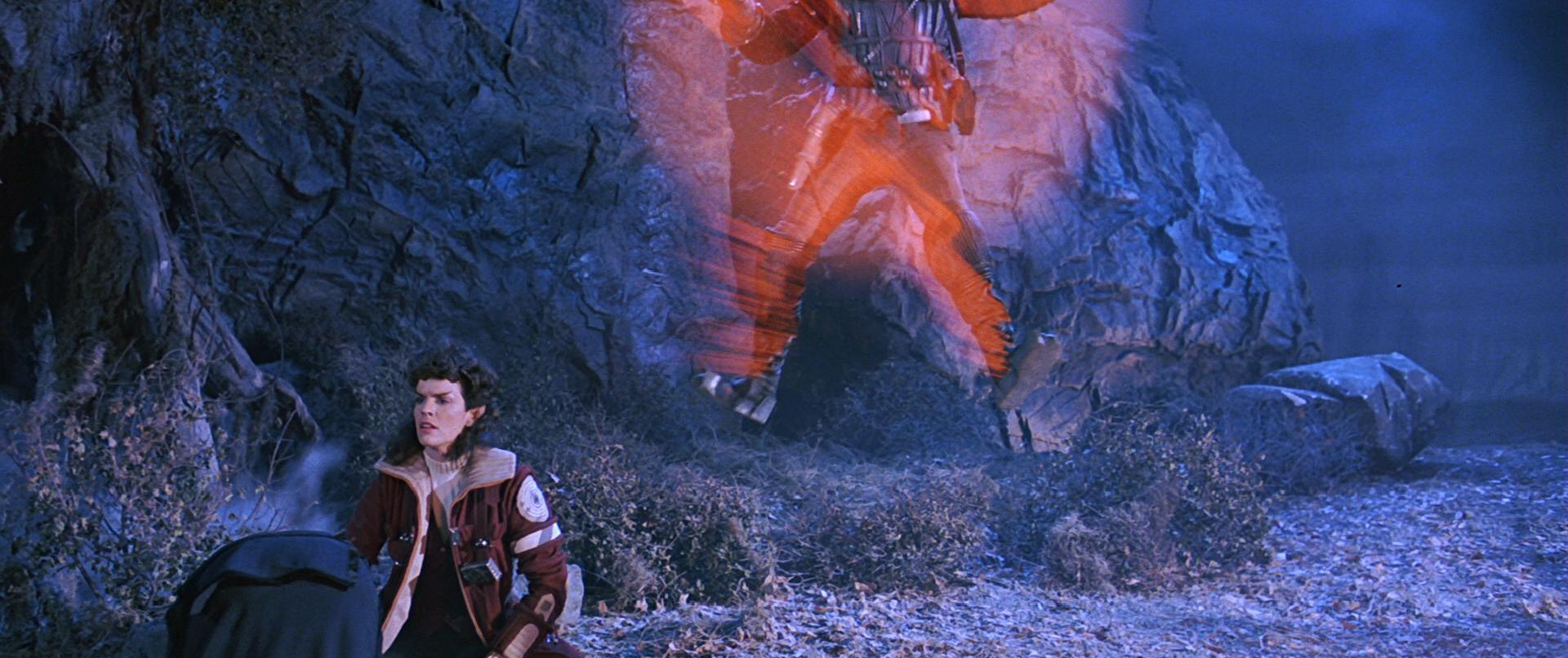
While many people tend to disregard this in order to claim lower phaser firepower, using "chain reaction" effect seen during TNG, that simply doesn't stand, beacouse we already know phasers are able to heat stones to 8 000 ° C, and NDF majic just cannot do that. Only energy transfer can.
There are sixteen power settings:
Level seven: Capable of vaporizing noranium carbide alloy. (TNG: "The Vengeance Factor")
Level ten: Kill setting, capable of killing a biological organism. (TNG: "Aquiel")
Level sixteen: Capable of vaporizing rock to widen an opening in a lava tube partially blocked by rubble, or blowing large holes in walls. (TNG: "Chain of Command, Part I", "Frame of Mind")
In order to get high end of phaser firepower, I will use two examples - from TOS, which seems to be clean vaporization, with no chain reaction, and therefore low end of phaser firepower, especially given that we talk about 24th and not 23rd century phasers. Basis is same, thought. Another is TNG vaporization, where hand phaser is capable of vaporizing stone.
Stone example firepower
Phasers are able to heat stones enough to glow (again - no chain reaction or other technobablle, just good ol' energy transfer - example "Silicon Avatar"). According to this, temperature should be 580 to 730 ° C.
Specific heat capacity of granite is 1.534 J(cm^3 x K). That means, to raise temperature of 1 cubic cm of granite by 1 kelvin (kelvin is essentialy same as °C) you need to bring 1.534 joules. Now, to heat granite from starting temperature of 25 ° C to 580 ° C we need to raise its temperature by 555 K. So we have equation E= 1.534 J (6 000 000 cm^3 x 555 K). (6 cubic meters is most we ever saw being cleanly vaporized). That gives us 5 x 10e9 joules or 5 gigajoules.
If we go with "Silicon Avatar" example, we have two hand phasers heating up approx. 2-5 cubic meters of rock within 5 seconds. That gives us 116 to 290 MW or 58 to 145 MW per phaser.
Power capacity
"The Galileo Seven"[TOS1] features the use of phasers drained into a shuttlecraft's engines to enable it to take off and make orbit. (I know it might be wierd beacouse I m using TOS event to calculate power capacity of TNG phaser, but I don't have anything better. I'm still going to use TNG shuttlecraft and not TOS one).
TOS shuttle is 7.44 meters long.
http://www.st-v-sw.net/STSWvolumetrics.html
According to that, Type 6 shuttle weights 29-113 tons. For TOS shuttle, I will assume mass of 48, 188 and 200 tons.
With this calculator we can calculate energy requirements to put shuttlecraft into orbit.
Low Earth orbit is 160 to 2 000 kilometers, but below 200 km objects experience orbital decay. Given that they were concerned with losing orbit after fuel was spent - and did lose orbit - I think it would be safe to assume that they were below 200 km. However, we don't know amount of energy they needed to hold orbit.
So we have this situation:
Mass - minimum energy to reach orbit
48t - 75.264 GJ
188t - 294.784 GJ
200 t - 313.6 GJ
We know five phasors were onboard. That would give us 15 to 60 GJ power capacity.
In TNG's "The Mind's Eye" we are informed that a phaser rifle power pack can easilly hold a charge of around 53.55 megajoules as a phaser rife was test fired with a stated output of 1.05 megawatts for 34 and 17 seconds (total of 51 seconds) with no sign in sight of the power pack charge being depleated. Energy efficiency is stated to be 94.1%, Data mentions that the normal phaser discharge crystal fires with 86.5% efficiency. That means that energy cell capacity is at least 53.55 megajoules. However, given that TOS hand phasers had over 280 times greater capacity than minimum capacity we can derive from this example, we can safely assume that power capacity of phaser rifle is considerably greater than minimal capacity we might calculate from "The Mind's Eye".
Conclusion
58 to 145 MW power output for phasers. "Chain reaction" seen in TNG phasers does nothing to disprove this - it is merely additional ability to conserve energy and make use of phasers realistically possible in CQC.
Also, in most cases there is no vapor produced. So "vaporization" is actually "disintegration. We already have a canon statement from ST:ENT's "In a Mirror, Darkly, Part 2" where Mirror Archer states that TOS phasers on their highest setting are a disintegration weapon.
Power capacity is around 75 to 313 gigajoules for TOS. If it is same for TNG, that would give 517 to 5397 seconds of continuous fire (8 minutes 36 seconds to 1 hour 29 minutes 57 seconds of continuous fire).
Notes
There is "no-recoil" issue, brought up on several places - it is possible that phasers have inertia dampeners to solve that problem, just like starships.
Also, hand phasers have ability of off-axis fire, and seem to have ability of auto-aim. It is possible that hand phaser is actually aimed at target at which person holding it looks ("eye aiming").
Plus, so-called NDF effect is actually impossible to use, beacouse it would create nuclear explosion.
P.S.: Thanks to people from StarfleetJedi.net for bringing up some issues about this page (vaporization/disintegration issue, no-recoil issue, information regarding "In a Mirror, Darkly" and "In Mind's Eye", correcting me on shuttlecraft weights), and suggesting "inertia dampeners" solution for hand phasers. I hope they will keep contributing, and not only for this page.
Pictures:
TNG-era hand phaser
Hand phaser heating rocs

Federation sublight drive
Federation impulse engines are primary means of propelling starship during sublight operations. In Federation starships, the impulse drive is essentially an augmented fusion rocket, usually consisting of one or more fusion reactors, an accelerator-generator, a driver coil assembly and a vectored thrust nozzle to direct the plasma exhaust. The fusion reaction generates a highly energized plasma. This plasma, ("electro-plasma") can be employed for propulsion, or can be diverted through the EPS to the power transfer grid, via EPS conduits, so as to supply other systems. The accelerated plasma is passed through the driver coils, thereby generating a subspace field which improves the propulsive effect.
Impulse engine can be used to maintain warp speed (TNG "Encounter at Farpoint"), but with lower efficiency than warp drive - that seems to suggest that warp drive is using EM field to generate warp field; other option is using gravitational distortion to acheve warp flight. Therefore, impulse engines and warp drive have similar model of operation, and while impulse drive is more effective in STL flight, it can be used as FTL drive; similarly, warp drive seems to supplement impulse drive in more demanding situations, and can be used for sublight propulsion.
Impulse speeds are inconsistent - a reference made in "Fair Haven" indicated that USS Voyager's impulse power would not be enough to outrun an approaching neutronic storm that was traveling at a velocity of 200,000 kilometers per second (447,387,258 miles per hour), or roughly 2/3 the speed of light. However, it is also commented in "Timeless" that at full impulse, Voyager can travel at roughly 80% light speed at impulse. It is possible that in "Fair Haven" case impulse drive was damaged; however, it is also possible that warp drive supplements impulse drive, therefore allowing starship to achieve greater speeds than possible by using impulse drive only.
Also, Enterprise D needed 23 minutes 17 seconds or 0.388 hours from Saturn to Mars (or Earth, as they were going to intercept cube). Minimum possible distance from Mars to Saturn is 1 097 900 000 km; that translates into speed of 3.5 x 10e10 kilometers per hour. Speed of light is around 1 080 000 000 kilometers per hour; this means that Enterprise-D was actually able to achieve faster-than-light velocity by using its impulse drive, as before that Riker gave command to "slow down to impulse" near Saturn.
On my site.
Impulse engine can be used to maintain warp speed (TNG "Encounter at Farpoint"), but with lower efficiency than warp drive - that seems to suggest that warp drive is using EM field to generate warp field; other option is using gravitational distortion to acheve warp flight. Therefore, impulse engines and warp drive have similar model of operation, and while impulse drive is more effective in STL flight, it can be used as FTL drive; similarly, warp drive seems to supplement impulse drive in more demanding situations, and can be used for sublight propulsion.
Impulse speeds are inconsistent - a reference made in "Fair Haven" indicated that USS Voyager's impulse power would not be enough to outrun an approaching neutronic storm that was traveling at a velocity of 200,000 kilometers per second (447,387,258 miles per hour), or roughly 2/3 the speed of light. However, it is also commented in "Timeless" that at full impulse, Voyager can travel at roughly 80% light speed at impulse. It is possible that in "Fair Haven" case impulse drive was damaged; however, it is also possible that warp drive supplements impulse drive, therefore allowing starship to achieve greater speeds than possible by using impulse drive only.
Also, Enterprise D needed 23 minutes 17 seconds or 0.388 hours from Saturn to Mars (or Earth, as they were going to intercept cube). Minimum possible distance from Mars to Saturn is 1 097 900 000 km; that translates into speed of 3.5 x 10e10 kilometers per hour. Speed of light is around 1 080 000 000 kilometers per hour; this means that Enterprise-D was actually able to achieve faster-than-light velocity by using its impulse drive, as before that Riker gave command to "slow down to impulse" near Saturn.
On my site.
četvrtak, 12. kolovoza 2010.
Federation warp core

If we take deuterium/antideuterium, that is total reactant mass of 0.08 kg per second or 59 545 720 kilograms of ultra-dense deuterium and its antimatter equivalent per second.
So we can calculate standard energy output of 7.2 x 10e15 watts or 7.2 PW for standard deuterium or 5.36 x 10e24 W (5 360 000 000 PW) for super-dense deuterium. However, one must note that "standard output" is output during normal subligh operations, i.e. warp drive disengaged, weaponry is not used etc. Maximum output might be as much as ten times greater.
Episode evidence
In "True Q"[TNG6], we hear the following exchange occur in Engineering:
Amanda: "It's hard to imagine how much energy is being harnessed in there."
Data : "Imagination is not necessary; the scale is readily quantifiable. We are presently generating 12.75 billion gigawatts per . . . "
One must understand that gigawatts per anything is actually gigawatts per anything. "Anything" here can stand for volume etc (it can't for mass beacouse, since it is M/AM reaction, energy gained from mass is always E=mc^2).
12.75 billion GW is 1.275 x 10e19 joules per second, which translates into 141.86 kilograms of fuel annihilated. Ultra-dense deuterium has density of 140 kilograms per cubic centimeter. Coincidence? I don't think so.
With that, we can calculate total output of E-D warp core to be 5.84 x 10e24 W or 5.84x10e12 TW (5 840 000 000 000 TW or 5 840 000 000 PW).
As for Star Wars power generation, see here:
http://www.st-v-sw.net/STSWimpower.html
UPDATE: Another possibility is that he was about to say "per pulse", which would lower total power production to 4.25 billion GW. That is equivalent of 1 gigaton per second.
UPDATE 2: In script, Data does say "per second".
On my site.
srijeda, 11. kolovoza 2010.
UFP Photon torpedo yield
Skin of Evil
Explosion of torpedo sends air blast/shockwave of around 150 kilometers in radius. Wong's nuclear effects calculator gives us 500 megatons for thermal radiation and 9.83 gigatons for air blast radius (lowest value).
However, fireball seems to be 50 kilometers in diameter which gives us 87 to 144 gigatons. So torpedo is anywhere between 500 megatons and 144 gigatons.
Pegasus
In beginning, we have this dialogue:
Pressman: "The Pegasus was prototype. Experimental engine, new weapon systems, in fact some of our designs were used in constructing the Enterprise. There are lot of things that Romulans would like to have their hands on"
Picard: "What are our orders?"
Pressman: "To find Pegasus. Salvage if possible, destroy if necessary."
------------------------
RIKER: I recommend we destroy the asteroid. It would take most of our photon torpedoes, but it would preclude any possibility of the Pegasus falling into Romulan hands. PRESSMAN: What the hell is the matter with you? Destroy the Pegasus before we've even taken a look at it?
RIKER: I thought it was more important that the Romulans
PRESSMAN: Well, you were wrong! We have a chance here to change the balance of power in this quadrant, but we can't very well do that if we destroy the Pegasus, now can we?
RIKER: No, sir.
------------------------
Later on, Enterprise is taken inside asteroid.


From these screenshots, we can conclude that asteroid is 8974 meters long, and 4487 meters wide on average. That would give volume of around 1.419 x 10e11 cubic meters. Given that quote number 3 was about destroying both Pegasus and asteroid, I will take it to mean that asteroid was about to be "vaporized". I will use energy required to destroy asteroid, and not any additional energy for destroying Pegasus, which should be vastly more difficult to destroy than asteroid.
Sphere of equivalent volume should be 3235.6869 meters in diameter. According to Mike Wong's asteroid destruction calculator, energy requirements for destruction of such asteroid are between 130 and 254 gigatons.
Now, we don't know exact number of torpedoes, but Enterprise-D carries 250 torpedoes, so I will take "most of" to mean anywhere between 140 and 240 torpedoes.
Conclusion: Federation torpedoes as of this episode are 542 megatons and 1.8 gigatons.
Die is Cast
----------------------------------------------------------------
Photon torpedos seem to have produced omni-directional explosions in early TNG, but after that it seems they've upgraded them to the point where they can produce directional explosions. Evidence of this is that after Q Who and The Nth Degree we never hear or see effects of photon torpedo backlash again, and in TNG's Quality of Life we find out they can shape the explosion of a photon torpedo:
RIKER: Then we need to shut down the particle fountain. What if we detonated a low yield photon torpedo within the particle stream? Wouldn't that shut it down?
FARALLON: We'd have to configure the torpedo very carefully. The shape of the shock wave would be critical. But it could work.
So photon torpedoes ARE shaped charges and direct almost entire blast towards their targets, despite some warsie arguments stating otherwise.
----------------------------------------
Variable yield has not only been confirmed by pure visual evidence, but also by dialogue from Star Trek : Enterprise, episode "Expanse":
Reed : "Photonic torpedoes. Their range is over fifty times greater than our conventional torpedoes. And they have a variable yield. They can knock the comm array off a shuttle pod without scratching the hull, or they can put a three kilometre crater into an asteroid."
as well as TNG episode "Code of Honor":
Picard : "Set them for a display blast a thousand metres short of the planets surface."
---------------------------------------
Some on SDN have claimed that episode "Genesis" proves low yield for photon torpedoes.
Link here:
http://bbs.stardestroyer.net/viewtopic.php?f=2&t=142124
That, however, is just intentional misinterpretation of sources. We are never said that torpedoes WERE fired with 11% greater yield; to contrary, torpedoes also got new guidance system, so it is logical that you will lower yield of torpedo before firing it. That, however, is one of last TNG episodes, so if that 11% rise in yield was kept, it could mean standard yield for new torpedoes is 602 megatons.
---------------------------------------
Some have claimed that visual effects disprove above yields. That, however, is wrong.
http://www.wwheaton.com/waw/mad/mad12.html
First, it is M/AM explosion, as opposed to classical nuclear explosion. Main product of that explosion are various types of radiation, mostly invisible but very damaging. Second, reactants in photon torpedo get annihilated relatively fast. So my guess is that, regardless of yield, we will see just very small, very bright flash which will disappear quickly, as soon as reaction finishes. But photon torpedoes are portrayed like strong chemical weapons by visual effects team (especially in newer instances, "First Contact" comes to mind). So, if we take stance that visual effects override everything, it would mean that torpedoes are not M/AM weapons, but rather just large, glowy artillery shells.
---------------------------------------
C is constant, and is always 299 792 458 meters per second.
Kiloton is 4.184 x 10e12 joules, and more precise converter is here.
---------------------------------------
Ultra-dense deuterium:
http://www.sciencedaily.com/releases/2009/05/090511181356.htm
---------------------------------------
Conclusion: Anti-ship torpedoes are 500 megatons as of TNG and 600 megatons as of late TNG. Yields for orbital bombardment end up from high megaton to high gigaton range.
On my site.
Pretplati se na:
Postovi (Atom)