Prikazani su postovi s oznakom star trek vs star wars. Prikaži sve postove
Prikazani su postovi s oznakom star trek vs star wars. Prikaži sve postove
petak, 7. listopada 2011.

ponedjeljak, 27. prosinca 2010.
MY WEB SITE FINISHED
Well, site is finished. You can check it out here.
OZNAKE:
photon torpedoes, photon torpedo yield, antimatter, antimatter weapons, federation, federation of planets, united federation of planets, star trek, star trek the next generation, pegasus, skin of evil, rise, photon torpedo range, the wounded, genesis, star trek the original series, star trek tos, a matter of honor, human error, the changeling, borg, scorpion, living witness, kyrians, q, the nth degree, quality of life, quantum torpedo, plasma warhead, star trek deep space nine, for the uniform, valiant, defiant, phasers, shipboard phasers, return to grace, ablative armor, uss defiant, uss prometheus, starship down, ablation, dissipation, deflector shields, graviton, graviton field, graviton membrane, em field, subspace field, yesterday's enterprise, shield frequency, star trek generations, regenerative shields, photon torpedo shields, star trek sensors, electromagnetic scanner, graviton telescope, interphasic scanner, lateral scanner, long range tachyon scanner, thermal guidance sensor, thermal interferometry scanner, transspectral imager, torque sensor, silicon avatar, the chase, the wounded, relics, impulse drive, timeless, fair haven, balance of terror, star trek the motion picture, where no man has gone before, the chase, the 37's, hope and fear, hand phasers, hand phaser, silicon avatar, the galileo seven, phaser rifle, phaser rifles, star trek first contact, star trek nemesis, photon grenades, star trek legacy, turkana city, the siege, smoke grenade, stun grenade, star trek sensors, tricorder, star trek infantry defense, body armor, homefront, nor the battle to the strong, mortars, air support, hopper, federation attack fighter, planetary defences, star trek planetary defences, star trek active planetary defences, star trek passive planetary defences, planetary shields, planetary coak, warp core, galaxy class warp core, GCS warp core power production, star trek power production, true q, the dauphin, star trek materials, tritanium, duranium, starfleet, size of starfleet, redemption, court martial, NCC, federation shipyards, 40 Eridani A Starfleet Construction Yards, Antares Ship Yards, Baikonur Cosmodrome, Beta Antares Ship Yards, Copernicus Ship Yards, McKinley Station, Marin County Starfleet yards, Oakland Fleet Yards, San Francisco Fleet Yards, Tranquility Base, Utopia Planitia fleet yards, turbolasers, turbolaser firepower, turbolaser range, revenge of the sith novelization, coruscant, the empire strikes back, turbolaser bolt, turbolaser objections, heavy turbolaser, medium turbolaser, light turbolaser, proton torpedoes, proton torpedo firepower, death star II reactor, hyperdrive, ion drive, star wars sublight drive, blaster, blasters, blaster firepower, blaster rifles, imperial air support, TIE bomber, TIE, X-wing, Y-wing, Galactic Empire, Galactic Republic, LAAT/i, imperial armor, walker, AT-AT, AT-ST, walker firepower, AT-AT firepower, AT-ST firepower, AT-AT speed, AT-ST speed, heat capacity of wood, republic armor, AT-TE, SPHAT, AT-TE firepower, AT-TE armor, AT-TE speed, SPHAT firepower, SPHAT armor, SPHAT speed, imperial artillery, republic artillery, star wars defensive tech, stormtrooper armor, stormtrooper, Endor, imperial ground sensors, imperial ground troops, star wars planetary defences, ion cannon, star wars planetary shields, alderaan shield fallacy, star wars power production, fusion, fission, star destroyer, imperial star destroyer, star destroyer power generation, the empire strikes back novelization, star wars materials, neutronium, nutronium hull, neutronium hull fallacy, transparasteel, durasteel, imperial fleet, imperial fleet size, size of imperial fleet, fleet of galactic empire, death star defenses, death star, death star II, death star scaling, size of federation, size of empire, milky way, star trek galaxy, star wars galaxy, territorry comparation, canon, star trek canon, star wars canon, paramount, lucasfilm, st-v-sw.net, darkstar, g2k, SDN, stardestroyer.net, SDN wiki, SFJ, starfleet jedi.net, SFJ wiki, mike wong, ditl, graham kennedy, the trek BBS, Spacebattles
OZNAKE:
photon torpedoes, photon torpedo yield, antimatter, antimatter weapons, federation, federation of planets, united federation of planets, star trek, star trek the next generation, pegasus, skin of evil, rise, photon torpedo range, the wounded, genesis, star trek the original series, star trek tos, a matter of honor, human error, the changeling, borg, scorpion, living witness, kyrians, q, the nth degree, quality of life, quantum torpedo, plasma warhead, star trek deep space nine, for the uniform, valiant, defiant, phasers, shipboard phasers, return to grace, ablative armor, uss defiant, uss prometheus, starship down, ablation, dissipation, deflector shields, graviton, graviton field, graviton membrane, em field, subspace field, yesterday's enterprise, shield frequency, star trek generations, regenerative shields, photon torpedo shields, star trek sensors, electromagnetic scanner, graviton telescope, interphasic scanner, lateral scanner, long range tachyon scanner, thermal guidance sensor, thermal interferometry scanner, transspectral imager, torque sensor, silicon avatar, the chase, the wounded, relics, impulse drive, timeless, fair haven, balance of terror, star trek the motion picture, where no man has gone before, the chase, the 37's, hope and fear, hand phasers, hand phaser, silicon avatar, the galileo seven, phaser rifle, phaser rifles, star trek first contact, star trek nemesis, photon grenades, star trek legacy, turkana city, the siege, smoke grenade, stun grenade, star trek sensors, tricorder, star trek infantry defense, body armor, homefront, nor the battle to the strong, mortars, air support, hopper, federation attack fighter, planetary defences, star trek planetary defences, star trek active planetary defences, star trek passive planetary defences, planetary shields, planetary coak, warp core, galaxy class warp core, GCS warp core power production, star trek power production, true q, the dauphin, star trek materials, tritanium, duranium, starfleet, size of starfleet, redemption, court martial, NCC, federation shipyards, 40 Eridani A Starfleet Construction Yards, Antares Ship Yards, Baikonur Cosmodrome, Beta Antares Ship Yards, Copernicus Ship Yards, McKinley Station, Marin County Starfleet yards, Oakland Fleet Yards, San Francisco Fleet Yards, Tranquility Base, Utopia Planitia fleet yards, turbolasers, turbolaser firepower, turbolaser range, revenge of the sith novelization, coruscant, the empire strikes back, turbolaser bolt, turbolaser objections, heavy turbolaser, medium turbolaser, light turbolaser, proton torpedoes, proton torpedo firepower, death star II reactor, hyperdrive, ion drive, star wars sublight drive, blaster, blasters, blaster firepower, blaster rifles, imperial air support, TIE bomber, TIE, X-wing, Y-wing, Galactic Empire, Galactic Republic, LAAT/i, imperial armor, walker, AT-AT, AT-ST, walker firepower, AT-AT firepower, AT-ST firepower, AT-AT speed, AT-ST speed, heat capacity of wood, republic armor, AT-TE, SPHAT, AT-TE firepower, AT-TE armor, AT-TE speed, SPHAT firepower, SPHAT armor, SPHAT speed, imperial artillery, republic artillery, star wars defensive tech, stormtrooper armor, stormtrooper, Endor, imperial ground sensors, imperial ground troops, star wars planetary defences, ion cannon, star wars planetary shields, alderaan shield fallacy, star wars power production, fusion, fission, star destroyer, imperial star destroyer, star destroyer power generation, the empire strikes back novelization, star wars materials, neutronium, nutronium hull, neutronium hull fallacy, transparasteel, durasteel, imperial fleet, imperial fleet size, size of imperial fleet, fleet of galactic empire, death star defenses, death star, death star II, death star scaling, size of federation, size of empire, milky way, star trek galaxy, star wars galaxy, territorry comparation, canon, star trek canon, star wars canon, paramount, lucasfilm, st-v-sw.net, darkstar, g2k, SDN, stardestroyer.net, SDN wiki, SFJ, starfleet jedi.net, SFJ wiki, mike wong, ditl, graham kennedy, the trek BBS, Spacebattles
petak, 12. studenoga 2010.
Holodeck
In episode "The Big Goodbye" we are informed that holodecs, are "highly useful for crew training" and "highly enjoyable when used for recreation". However, there are also several other things worth noting - Picard is "not dressed properly" and spot from lipstick holodeck character gave him remained after he exited holodeck, which seems to suggest that, while most of it is illusion created by forcefields and holograms, at least some items are replicated (it is reinforced by "Angel One" when Picard, passing near holodeck, gets hit by snowball throught open doors). Since it is unlikely starship will carry huge amounts of lipstick to be used in replicators as needed, it seems to suggest that at least some level of manipulation on mollecular level can be achieved, if not at atomic/subatomic level.
četvrtak, 11. studenoga 2010.
Death Star II
Before being banned on SDN I have recieved lot of complaints why Federation should not be able to destroy DSII. Microconduits... which we never saw used by Empire. It was also argued that conduit throught which Rebels flew inside was to be removed after construction was finished... which is, to say at least, ridiculous, as seen from following screenshot.


Folks at SDN argue that it was impossible for Rebels to destroy Death Star II after it was completed and that it was main reason why they attacked it. Wrong. Main reason for attack was fact that Emperor was going to be there. Secondary reason was promptly displayed when DSII destroyed cruiser Liberty. Superlaser of DSI was unable to target capital ships.
Also, much simpler solution would be to just put chimney caps. Constructing thousands or millions of micro-exhaust ports with each being over 90 kilometers long (due to zig-zag structure of vents) would be engineering and logistical nightmare, not to mention that construction would be delayed enough to make canon timeframe impossible.
Dreadnought
Dreadnought is nickname Maquis gave to former Cardassian missile. It is self-contained tactical missile. It carries warhead that contains 1000 kg of matter and 1000 kg of antimatter giving it 43-gigaton yield; it is also adaptible, evasive and armed with its own defensive weaponry - in other words, unstoppable. So, warhead itself was big deal, but its other characteristics were what made it such big deal.
Later in episode, we get a look at several other characteristics - it was able to scan and adapt to Starfleet weapons in part of second, rendering them almost completely ineffective.
Later in episode, we get a look at several other characteristics - it was able to scan and adapt to Starfleet weapons in part of second, rendering them almost completely ineffective.
četvrtak, 4. studenoga 2010.
On meaning of isoton
Well, here we are. Isoton - probably wierdest and most debatable unit of measurment in Star Trek. I have two theories about its meaning - mass of reactants or equivalent of yield produced by same amount of ultrilitium.
utorak, 26. listopada 2010.
My st-vs-sw website (in development)
I started my work on st-vs-sw website but I don't know when, or if, I will upload it.
UPDATES AND NEWS:
3. 12. 2010: Updated "Photon torpedo" page. (I often work on several pages simultaneously, so several pages might often be finished in rapid succession, althought average page takes at least week to finish, often much more, and that not counting updates).
5. 12. 2010: Finished "Phasers" (shipboard) page and updated "Photon torpedo" page.
6. 12. 2010: Finished Star Trek "Mortars" page.
7. 12. 2010: Changed design of pages into something more visually acceptable.
8. 12. 2010: Finished "Turbolasers" page
11. 12. 2010: Finished Star Trek "Sensors" (ground) page and Star Wars "Shields", "Active planetary defences" and "Passive planetary defences" pages, with all pages being micro-pages or bordering on that size. I must say that I expected ISD shields to be a bit more powerful, but who am I to argue against math?
12. 12. 2010: Finished Star Trek "Warp drive", "Active planetary defences" and "Passive planetary defences" pages
13. 12. 2010: Finished Star Trek "Hand phasers" and "Phaser rifles" pages, latter of which with extreme usage of materials from this blog.
14. 12. 2010: Finished Star Trek "Grenades" page
15. 12. 2010: Finished Star Trek "Air Support", "Defensive Tech" and "Galaxy class starship warp core" pages
16. 12. 2010: Added "Fuel" section to Galaxy class warp core page, with lot of interesting speculation
17. 12. 2010: Finished Star Trek "Deflector shields", "Regenerative shields" and "Ablative armor" pages
18. 12. 2010: Finished Star Wars "Galactic Empire air support" and "Death Star scaling" pages and Star Trek "Size of Starfleet" page
19. 12. 2010: Finished Star Trek "Impulse drive", "Torpedoes - other" and "Starship sensors" pages. "Materials" page might be considered finished, but I would appreciate more data
20. 12. 2010: Finished "Republic armor", "Imperial armor", "Blasters", "Republic air support", "Blaster rifles" and "Shipboard sensors" pages
21. 12. 2010: Finished "Imperial fleet size", "Imperial sensors - ground" and "Imperial defensive tech" (ground) pages.
22. 12. 2010: Finished Star Wars "Power production" page
23. 12. 2010: Finished Star Wars "Hyperdrive" and "Materials" pages
11. 11. 2010: Finished photon torpedo page. Updates in future possible, but unlikely.
26. 11. 2010: Just made some measurements for "Rise" asteroid.
3. 12. 2010: Updated "Photon torpedo" page. (I often work on several pages simultaneously, so several pages might often be finished in rapid succession, althought average page takes at least week to finish, often much more, and that not counting updates).
5. 12. 2010: Finished "Phasers" (shipboard) page and updated "Photon torpedo" page.
6. 12. 2010: Finished Star Trek "Mortars" page.
7. 12. 2010: Changed design of pages into something more visually acceptable.
8. 12. 2010: Finished "Turbolasers" page
11. 12. 2010: Finished Star Trek "Sensors" (ground) page and Star Wars "Shields", "Active planetary defences" and "Passive planetary defences" pages, with all pages being micro-pages or bordering on that size. I must say that I expected ISD shields to be a bit more powerful, but who am I to argue against math?
12. 12. 2010: Finished Star Trek "Warp drive", "Active planetary defences" and "Passive planetary defences" pages
13. 12. 2010: Finished Star Trek "Hand phasers" and "Phaser rifles" pages, latter of which with extreme usage of materials from this blog.
14. 12. 2010: Finished Star Trek "Grenades" page
15. 12. 2010: Finished Star Trek "Air Support", "Defensive Tech" and "Galaxy class starship warp core" pages
16. 12. 2010: Added "Fuel" section to Galaxy class warp core page, with lot of interesting speculation
17. 12. 2010: Finished Star Trek "Deflector shields", "Regenerative shields" and "Ablative armor" pages
18. 12. 2010: Finished Star Wars "Galactic Empire air support" and "Death Star scaling" pages and Star Trek "Size of Starfleet" page
19. 12. 2010: Finished Star Trek "Impulse drive", "Torpedoes - other" and "Starship sensors" pages. "Materials" page might be considered finished, but I would appreciate more data
20. 12. 2010: Finished "Republic armor", "Imperial armor", "Blasters", "Republic air support", "Blaster rifles" and "Shipboard sensors" pages
21. 12. 2010: Finished "Imperial fleet size", "Imperial sensors - ground" and "Imperial defensive tech" (ground) pages.
22. 12. 2010: Finished Star Wars "Power production" page
23. 12. 2010: Finished Star Wars "Hyperdrive" and "Materials" pages
nedjelja, 10. listopada 2010.
Energy requirements for Base Delta Zero and General Order 24
General Order 24
"This is the commander of the U.S.S. Enterprise. All cities and installations on Eminiar 7 have been located, identified, and fed into our fire control system. In 1 hour and 45 minutes, the entire inhabited surface of your planet will be destroyed. You have that long to surrender your hostages."
Combined area of largest metropolises on Earth is 134 141 km^2. E-D has 250 photon torpedoes, and due to only taking largest cities as norm, I will ignore phasers. That gives 357 square kilometers per torpedo, or 250 circles with radius of 13 kilometers.
Area of urban areas on Earth is 1.5% of land mass area or 2 234 100 square kilometers - or 8 936 km^2 per torpedo - which is area of circle with radius of 53.3 kilometers.
With Wong's calculator, first value gives us 120 megatons and the second 8.1 gigatons per torpedo - both are low end values, but are balanced out by not taking phasers into account. However, first value takes only few largest metropolises on Earth, and is low-end value. Considering that quote is from 23rd century, and that Enterprise-D probably carries much larger number of torpedoes than Constitution class (or much more powerful torpedoes) due to Galaxy class being 8 times larger in volume, second value might also be conservative - however, it is balanced out by fact that Eminiar 7 might have smaller urban population than modern-day Earth. Following screenshot, however, suggests over 11 000 000 square kilometers of urban area - or 250 circles each with radius of 118 kilometers, or 90 gigatons per torpedo, assuming all damage is done by torpedoes - I doubt more than 50-75% of damage will be done that way.

Scotty: "We could blast our way throught that field but only at risk of destroying captain, mr Spock and every other living thing at Elba 2."
McCoy: "How could we be powerful enough to destroy a planet and still be so helpless."
Also, in DS9 episode "Broken Link" Garak states that "we have firepower on this ship to turn that planet into smoking cinder". He might have been tailor, but he was Obsidian Order operative and Worf does not contradict him.
Dialogue here:
WORF: Garak. Just as I thought.
GARAK: Don't tell me. I overlooked one of the security monitors.
WORF: You were trying to override the launch controls for the quantum torpedoes.
GARAK: I was hoping to gain control of the phasers as well. I just hadn't got around to it yet. Don't you see? We have an opportunity here. A chance to end the Dominion threat once and for all. We have enough firepower on this ship to turn that planet into a smoking cinder. Personally, I think that would be a very good thing.
WORF: And what about Odo, and Captain Sisko and Doctor Bashir?
GARAK: They'll die. And once the Jem'Hadar ships realise what we're doing, so will we. But what are our lives compared to saving the entire Alpha Quadrant?
WORF: We are not here to wage war.
GARAK: I'm not talking about war. What I'm proposing is wiping out every Founder on that planet. Obliterating the Great Link. Come now, Mister Worf, you're a Klingon. Don't tell me you'd object to a little genocide in the name of self-defence?
WORF: I am a warrior, not a murderer.
GARAK: What you are is a great disappointment.
(They fight. Worf finally gets the upper hand.)
WORF: You fight well for a tailor.
Base Delta Zero
"Base Delta Zero is the Imperial code order to destroy all population centres and resources, including industry, natural resources and cities."
I will use that quote to calculate BDZ energy requirements. NOTE: BASE DELTA ZERO IS LOW CANON AND AS SUCH IS OVERRIDDEN BY G CANON AND CALCULATIONS DERIVED FROM G CANON, ESPECIALLY CONSIDERING AMOUNT OF SPECULATIONS.
"This is the commander of the U.S.S. Enterprise. All cities and installations on Eminiar 7 have been located, identified, and fed into our fire control system. In 1 hour and 45 minutes, the entire inhabited surface of your planet will be destroyed. You have that long to surrender your hostages."
Combined area of largest metropolises on Earth is 134 141 km^2. E-D has 250 photon torpedoes, and due to only taking largest cities as norm, I will ignore phasers. That gives 357 square kilometers per torpedo, or 250 circles with radius of 13 kilometers.
Area of urban areas on Earth is 1.5% of land mass area or 2 234 100 square kilometers - or 8 936 km^2 per torpedo - which is area of circle with radius of 53.3 kilometers.
With Wong's calculator, first value gives us 120 megatons and the second 8.1 gigatons per torpedo - both are low end values, but are balanced out by not taking phasers into account. However, first value takes only few largest metropolises on Earth, and is low-end value. Considering that quote is from 23rd century, and that Enterprise-D probably carries much larger number of torpedoes than Constitution class (or much more powerful torpedoes) due to Galaxy class being 8 times larger in volume, second value might also be conservative - however, it is balanced out by fact that Eminiar 7 might have smaller urban population than modern-day Earth. Following screenshot, however, suggests over 11 000 000 square kilometers of urban area - or 250 circles each with radius of 118 kilometers, or 90 gigatons per torpedo, assuming all damage is done by torpedoes - I doubt more than 50-75% of damage will be done that way.

However, this quote is interesting.
Kirk: "We make the real thing, Councelor. I could destroy this planet."
It could mean that Enterprise can destroy every inhabited area on planet.
CONCLUSION: 23rd century photon torpedoes are between 8 and 50 gigatons in yield.
UPDATE: GO24 firepower is confirmed by episode "Whom gods Destroy". Outpost is covered with planetary shield and it is stated that Big E "can blast throught that shield but only at cost of destroying Captain Kirk, Mr. Spock and every other living thing on Elba 2." This seems to suggest that planet would be totally devastated even by collateral damage of blowing throught planetary shield, which might bump up firepower from GO24 as much as OOM.
Sulu: "We can't beam anyone down sir. Forcefield on planet is in full operation and all forms of transport into asylum dome are blocked."
Scotty: "We could blast our way throught that field but only at risk of destroying captain, mr Spock and every other living thing at Elba 2."
McCoy: "How could we be powerful enough to destroy a planet and still be so helpless."
Also, in DS9 episode "Broken Link" Garak states that "we have firepower on this ship to turn that planet into smoking cinder". He might have been tailor, but he was Obsidian Order operative and Worf does not contradict him.
Dialogue here:
WORF: Garak. Just as I thought.
GARAK: Don't tell me. I overlooked one of the security monitors.
WORF: You were trying to override the launch controls for the quantum torpedoes.
GARAK: I was hoping to gain control of the phasers as well. I just hadn't got around to it yet. Don't you see? We have an opportunity here. A chance to end the Dominion threat once and for all. We have enough firepower on this ship to turn that planet into a smoking cinder. Personally, I think that would be a very good thing.
WORF: And what about Odo, and Captain Sisko and Doctor Bashir?
GARAK: They'll die. And once the Jem'Hadar ships realise what we're doing, so will we. But what are our lives compared to saving the entire Alpha Quadrant?
WORF: We are not here to wage war.
GARAK: I'm not talking about war. What I'm proposing is wiping out every Founder on that planet. Obliterating the Great Link. Come now, Mister Worf, you're a Klingon. Don't tell me you'd object to a little genocide in the name of self-defence?
WORF: I am a warrior, not a murderer.
GARAK: What you are is a great disappointment.
(They fight. Worf finally gets the upper hand.)
WORF: You fight well for a tailor.
Base Delta Zero
"Base Delta Zero is the Imperial code order to destroy all population centres and resources, including industry, natural resources and cities."
I will use that quote to calculate BDZ energy requirements. NOTE: BASE DELTA ZERO IS LOW CANON AND AS SUCH IS OVERRIDDEN BY G CANON AND CALCULATIONS DERIVED FROM G CANON, ESPECIALLY CONSIDERING AMOUNT OF SPECULATIONS.
Timeframe: Base Delta Zero has been said to be "matter of hours". This means it takes more than one hour, but less than full day. Probably less than 6 hours, since six hours is "half day work".
We don't know how many ships are involved in this, but we can take some guesses:
"System bombards are used when the Empire would rather completely destroy a world rather than see it fall into Rebel hands."
"System bombard contains an average of 100 ships divided between three bombard squadrons and a light squadron. If an admiral feels that force superiority has done less than a thorough job of removing hostile craft from the system, a system bombard squadron will be augmented with ships from the light squadron."
As per the Sourcebook, the 100 ship fleet may include a few ISDs.
Task Force 58 at one point had 9 aircraft carriers, 7 fast battleships, 6 heavy cruisers, 4 light cruisers and 28 destroyers. Given that ISD's are Imperial battleships/carriers, I will take that "few" means anywhere from 12 to 29 Star Destroyers.
As a wild guess, I will assume 5 000 000 square kilometers destroyed. I still need to obtain ROF of Imperial turbolasers.
From Tantive IV pursuit scene, light turbolasers seem to have ROF of 3 shots per second. Medium ones seem to be able to fire 1 shot every 3 seconds. There seem to be 8-10 medium TL emplacements, so we have 2-3 shots per second. Heavy TL might be able to fire 1 shot every 10 seconds.
EU gives 72 heavy turbolasers and 19 medium turbolasers - so we have 7.2 heavy and 6.3 medium bolts per second.
I will give 3 hours as timeframe for BDZ (wildly generous, but there we go). In that timeframe we can count 25 920 heavy and 22 600 medium bolts. I will take heavy turbolasers as being 100 times stronger than medium ones - so we have 26 146 equivalent heavy TL bolts. Each would have to destroy area of 191 square kilometers, or equivalent of circle with radius of 7.8 kilometers.
I will use Wong's calculator, which gives us 24 megatons for air-blast radius with total fatalities, and 1.4 gigatons for minimum fireball radius.
Medium TL bolts therefore should be 240 kilotons to 14 megatons per shot.
CONCLUSION: Heavy turbolasers as based on BDZ are 24 megatons to 1.4 gigatons, and medium ones are 240 kilotons to 14 megatons.
petak, 8. listopada 2010.
ICS fallacies
200 gigaton heavy turbolasers on Republic transport ship - nonexistent.


Base Delta Zero - just take look at following quotes:
"The First Sun is a repulsorlift infantry regiment designed primarily to run search-and-destroy missions, which he troops of the unit jocularly refer to as SLAMs (Search, Locate, Annihilate mission). Indeed, the regiment often undertakes missions with the same objective as the "Base Delta Zero" command: the elimination of all assets of production, including factories, land, mines, fisheries, droids, and sapient beings (particularly any witnesses that may have seen atrocities being commited)."--Galaxy Guide 9: Fragments from the Rim
" "Sir, what about bombardment? Is there a stage for that?"
"Blasting a planet from orbit is easy -- you don't need me to tell you how to do that. Limited orbital strikes would occur during the invasion stage. Just hope you are never given a Base Delta Zero order, lieutenant. Ah, yes, another question?"
"Sir, what's the Base Delta Zero order?"
"Base Delta Zero is the Imperial code order to destroy all population centres and resources, including industry, natural resources and cities. All other Imperial codes are subject to change, as you well know, but this code is always the same to prevent any confusion when the order is given. Base Delta Zero is rarely issued. ...."
-- "A World to Conquer" "
ponedjeljak, 4. listopada 2010.
Star Trek vs Star Wars - nature of technology
Star Wars
Star Wars technology seems to be based on extensive use of EM technology - repulsors at least are EM based, which is based on their performance. Also, ISD was forced to shoot asteroids to keep them out of way.
(unfinished)
Star Trek
Star Trek technology is particle-based, including extensive use of gravitons and gravitational technology, plus manipulation of space-time continuum (warp drive; SW hyperdrive probably does similar thing). Shields are at least partially graviton-based.
(unfinished)
Star Wars technology seems to be based on extensive use of EM technology - repulsors at least are EM based, which is based on their performance. Also, ISD was forced to shoot asteroids to keep them out of way.
(unfinished)
Star Trek
Star Trek technology is particle-based, including extensive use of gravitons and gravitational technology, plus manipulation of space-time continuum (warp drive; SW hyperdrive probably does similar thing). Shields are at least partially graviton-based.
(unfinished)
nedjelja, 26. rujna 2010.
"Star Trek canon database" analysis
http://www.stardestroyer.net/Empire/Database/Query-ST.php?Series=TNG&Category=Naval+Tactics&EpName=&Keywords=&Quotes=&Analysis=&Submit=Submit
"Naval Tactics: the great Captain Picard abandoned his ship and left it drifting through space, still intact! This is absolutely incomprehensible. No competent military officer would ever leave his vessel adrift, disabled but intact. A competent military officer would scuttle his ship to keep its technology and weaponry from falling into the wrong hands. "
Mr. Wong obviously forgot that Stargazer took battle damage beforehand, and that auto-destruct might have been offline. Such thing happened in few Star Trek episodes.
"We also see that it attempts to "flank" the Enterprise, and Picard's response indicates that gaps in the firing arc of Federation starships have not changed much from the days of Captain Kirk. Without gaps in its firing arcs, there would be no point to a flanking maneuver. "
Except that most of GCS firepower comes from its torpedo launchers, which are unable to hit targets flanking GCS.
"Naval Tactics: the Enterprise is very close to the Lysian Command Centre as seen below, yet it's still not in "optimum firing range!" "
Actually, we know from several previous episodes about backlash damage. Which means that "optimum firing range" is greater than range displayed, not lower.
"If it takes almost all of the USS Enterprise's 275 photon torpedoes to do this, then we can conclude that photon torpedo yield is between 110 and 450 kilotons (keep in mind that this is a rather generous estimate since the asteroid was hollow so it was obviously not well-consolidated, thus making it easier to fragment). "
Not only they needed to destroy "Pegasus" and its cloaking device (which is around meter in height and lot less in diameter, if I recall correctly); they needed to do it in way that Romulans would never discover that Pegasus had any illegal cloaking device on-board, or that ship ever existed in first place. Finding piece of rock with Federation hull fragment embedded in it would pretty much point out both of these facts to Romulans. And rest of Starfleet, since it seems that Section 31 was behind all that. Which means they required vaporization, giving us yields in low gigatons.
"Naval Tactics: the great Captain Picard abandoned his ship and left it drifting through space, still intact! This is absolutely incomprehensible. No competent military officer would ever leave his vessel adrift, disabled but intact. A competent military officer would scuttle his ship to keep its technology and weaponry from falling into the wrong hands. "
Mr. Wong obviously forgot that Stargazer took battle damage beforehand, and that auto-destruct might have been offline. Such thing happened in few Star Trek episodes.
"We also see that it attempts to "flank" the Enterprise, and Picard's response indicates that gaps in the firing arc of Federation starships have not changed much from the days of Captain Kirk. Without gaps in its firing arcs, there would be no point to a flanking maneuver. "
Except that most of GCS firepower comes from its torpedo launchers, which are unable to hit targets flanking GCS.
"Naval Tactics: the Enterprise is very close to the Lysian Command Centre as seen below, yet it's still not in "optimum firing range!" "
Actually, we know from several previous episodes about backlash damage. Which means that "optimum firing range" is greater than range displayed, not lower.
"If it takes almost all of the USS Enterprise's 275 photon torpedoes to do this, then we can conclude that photon torpedo yield is between 110 and 450 kilotons (keep in mind that this is a rather generous estimate since the asteroid was hollow so it was obviously not well-consolidated, thus making it easier to fragment). "
Not only they needed to destroy "Pegasus" and its cloaking device (which is around meter in height and lot less in diameter, if I recall correctly); they needed to do it in way that Romulans would never discover that Pegasus had any illegal cloaking device on-board, or that ship ever existed in first place. Finding piece of rock with Federation hull fragment embedded in it would pretty much point out both of these facts to Romulans. And rest of Starfleet, since it seems that Section 31 was behind all that. Which means they required vaporization, giving us yields in low gigatons.
Imperial shields
Mike Wong estimated that ISD's survived 30 minutes of battle with Mon Cal cruisers before losing shields. Heavy turbolasers are 1.5 megatons and medium ones are 15.6 kilotons.
http://www.youtube.com/watch?v=Oma9uPz9YYk
Here we have corvette pumping out 5 shots per second and ISD 2-3 per second. If we take ISD being able to fire 1 heavy turbolaser shot every 8 seconds (as it seems from movie - at around 6:28 at 6:36 we have same ISD firing one heavy shot), that translates in 9000 medium and 225 heavy shots - or 126.45 to 925.2 megatons for shields of Mon Calamari Star Cruiser. ISD's shields should be similar in strength or slightly stronger (maybe up to 150 to 1500 megatons), althought EU states that MonCal star cruisers had stronger shields, and ISD's better amor. So ending value would be 130 to 1000 megaton shields for ISD.
UPDATE: I have been warned that Mike Wong's estimation for 30-minute battle is wrong - time of entire battle is less than 30 minutes, and ISD's start losing shields long before that. I will have to re-watch movie later (I currently don't have enough time) and make my own estimates.
UPDATE 2: I have made estimates at my site.
http://www.youtube.com/watch?v=Oma9uPz9YYk
Here we have corvette pumping out 5 shots per second and ISD 2-3 per second. If we take ISD being able to fire 1 heavy turbolaser shot every 8 seconds (as it seems from movie - at around 6:28 at 6:36 we have same ISD firing one heavy shot), that translates in 9000 medium and 225 heavy shots - or 126.45 to 925.2 megatons for shields of Mon Calamari Star Cruiser. ISD's shields should be similar in strength or slightly stronger (maybe up to 150 to 1500 megatons), althought EU states that MonCal star cruisers had stronger shields, and ISD's better amor. So ending value would be 130 to 1000 megaton shields for ISD.
UPDATE: I have been warned that Mike Wong's estimation for 30-minute battle is wrong - time of entire battle is less than 30 minutes, and ISD's start losing shields long before that. I will have to re-watch movie later (I currently don't have enough time) and make my own estimates.
UPDATE 2: I have made estimates at my site.
nedjelja, 5. rujna 2010.
Normal cloak
"In the Star Trek universe, the cloaking device supposedly generates a "spatial distortion" which causes light and sensor rays to travel around the ship, so that nothing is reflected from its surface. Such an in intense distortion – equivalent to an enormous mass concentration, such as that in the vicinity of a black hole or neutron star – would certainly crush the ship and crew unless additional measures were taken to counteract the effect inside the distortion."
However, that theory is thrown right throught window by existence of graviton-based shields - hence my idea that cloaking device just modifies shields in order to hide ship. That also explains why Scimitar was able to raise shields while cloaked - it had primary and secondary shields, and only secondary were used for cloaking. Primary shields remained up.
Romulan cloaking device
(unfinished)
Klingon cloaking device

(unfinished)
Federation Interphase cloak
See here.
However, that theory is thrown right throught window by existence of graviton-based shields - hence my idea that cloaking device just modifies shields in order to hide ship. That also explains why Scimitar was able to raise shields while cloaked - it had primary and secondary shields, and only secondary were used for cloaking. Primary shields remained up.
Romulan cloaking device
(unfinished)
Klingon cloaking device

(unfinished)
Federation Interphase cloak
See here.
subota, 4. rujna 2010.
Federation interphase cloak

Basics
Interphase cloak operates on principle of "phasing" cloaked object out of normal timespace continuum. Ships using it can pass throught solid objects; their ability to pass throught forcefields is unknown. It is possible that weapons fire would simply pass throught cloaked ship without interferance; that, however, is unconfirmed.
Undetectability level
Very high, as Romulan Warbird did not notice Enterprise-D passing throught rock few hundred meters away until it decloaked. For comparation, Enterprise' crewmen who got cloaked by accident involving Romulan Interphase cloak left residual traces and gave off chronitn fieldphenomena when passing throught walls. Also the fact that they did not fell throught floor is, to say at least, wierd.
Safety
Geordy: "Commander, we ran impulse engines throught the plasma conduits, but you might wanna watch the intercoolar levels. If they get too high, they will blow entire relay system."
It is implied that Pegasus's cloak blew plasma relay system, so ship decloaked while passing throught asteroid.
subota, 28. kolovoza 2010.
Territory and population (unfinished)
Size of Empire
http://picard578.blogspot.com/2010/11/sw-galaxy-size.html
Also:
http://www.st-v-sw.net/STSWcompare.html
Size of Federation
In Dominion War we have projected casualties of around 900 billion. That suggests 1.2 to 2 trillion population, which allows for 200 to 500 relatively heavily populated planets. My estimate for human population is between 35 and 70 billion, 50 to 60 billion optimum. That would mean humans count for 1.75 to 5.8 % of total population.
From First Contact we know that "there are 150 planets in Federation, spread over 8 000 light years". Given that Kirk says that "humanity is on thousand worlds and spreading" over century earlier, I would take quote of 150 planets to mean full members, with unindentified number of colonies, probably some thousands.
Territory comparation at my site.
http://picard578.blogspot.com/2010/11/sw-galaxy-size.html
Also:
http://www.st-v-sw.net/STSWcompare.html
Size of Federation
In Dominion War we have projected casualties of around 900 billion. That suggests 1.2 to 2 trillion population, which allows for 200 to 500 relatively heavily populated planets. My estimate for human population is between 35 and 70 billion, 50 to 60 billion optimum. That would mean humans count for 1.75 to 5.8 % of total population.
From First Contact we know that "there are 150 planets in Federation, spread over 8 000 light years". Given that Kirk says that "humanity is on thousand worlds and spreading" over century earlier, I would take quote of 150 planets to mean full members, with unindentified number of colonies, probably some thousands.
Territory comparation at my site.
petak, 27. kolovoza 2010.
Federation shields (unfinished)
Shield physics
Federation shields are weird things, blocking some but not other things; often, one can bypass shields just by getting right frequency. According to display shown below, shields are composed from gravitons - that explains how they stop particle and projectile weapons - but also must have EM/electronic component. Shields seem to operate on same principles like forcefields that we see on starships, blocking corridors in case of emergency etc.
Shield percentage
When shields are hit by weapons, shield strength falls, and that is expressed in percentages. Here we have another proof that shields use some kind of particles that are knocked out by successive hits, since not only that shields degrade by same/similar percentage with every hit, but also do not seem to be blocking entire quantity of energy directed on ship; efficiency seems to be degrading with successive hits. That also means that it is possible that shield percentage also shows their efficiency - so, shields at 100% will stop all of energy directed on target, but shields at 30% will stop only 30% of energy that hits them - at least when it is about energy weapons. That is only theory, thought. Also, screenshot below seems to confirm that shields are at least partially graviton-based; that is possible, since majority of powers uses particle-based weapons (disruptors, phasers).
That my theory is confirmed by "Besto of Both Worlds". When Borg fire shield-draining weapon on Enterprise, Worf reports: "Shield effectiveness has been reduced 12%". After second shot, he reports "Shields have been reduced 41%".
Shield frequencies and modulation

Here we have 3 things:
-confirmation that shields are indeed graviton-based
-energy output of shields
-shield modulation
Second value is most interesting beacouse it could give us strength of Galaxy-class starship's shields.
As we see here, cochrane is unit for subspace distortion, implying that at least some of Federation weaponry might be subspace-based or have subspace-based component. Other possibility is that subspace field is used to "hold" gravitons in place. Gravitons are theoretical particles responsible for gravitation - theoretically, exchange in gravitons between two masses is what creates gravity. Given that most Star Trek weaponry is particle-based, such shields would be very effective, however, magnetic field is still required against EM-based weaponry like lasers (althought, given that laser beams are composed of photons, graviton shields would be at least partially effective - light itself exhibits properties of both waves and particles) [1] [2] [3].
So Star Trek shields have 3 components - gravitational, electromagnetic and subspace. Unfortunately, that means we can't accurately quantify their strength beacouse it will vary depending on nature of threat.
Also, shield frequency seems to suggest that Federation shields are not permament barrier, but that shields are turned on, shut down and then again turned on many times in second (257.4 million times per second as per screen from "Generation"). Star Trek weapons are also frequency-based, which explains possibility of weapon fire passing throught shields by matching frequency. Also, "regenerative shields" used by Borg and tested by Federation on USS Prometheus work by analyzing frequency of enemy weapons and matching frequency to completely stop weapons fire.
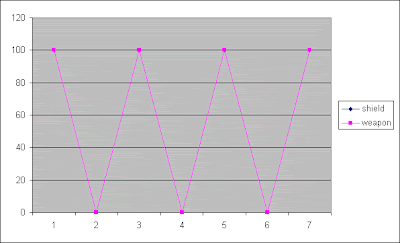


Shield strength from "Relics"
Enterprise-D held orbit in Cromosphere. Altitude was 150 000 kilometers (presumably from surface of star). Temperature of corona is more than 10e6 K (1 000 000 to 6 000 000 K at density of about 100 million to 1 billion particles.
"... the coronal cloud has a thermal energy of 10e51 ergs at 20 kpc..."
1 erg is 10e(-7) J. 1 kpc is 10e19 m or 10e17 km. At 150 000 km energy should be 3.9 x 10e46 J or 9.32 x 10e27 Gt over area of 8.98 x 10e18 square meters. Surface area of E-D shields is 321 700 m^2 when seen from side. Resulting absorbed energy is bit too high (1.397x10e33 J), so I guess I'll have to check all of calculations later.
(unfinished)
Shield geometry
Shields can have oval and hull-hugging shape.
Other uses
Federation shields are weird things, blocking some but not other things; often, one can bypass shields just by getting right frequency. According to display shown below, shields are composed from gravitons - that explains how they stop particle and projectile weapons - but also must have EM/electronic component. Shields seem to operate on same principles like forcefields that we see on starships, blocking corridors in case of emergency etc.
Shield percentage
When shields are hit by weapons, shield strength falls, and that is expressed in percentages. Here we have another proof that shields use some kind of particles that are knocked out by successive hits, since not only that shields degrade by same/similar percentage with every hit, but also do not seem to be blocking entire quantity of energy directed on ship; efficiency seems to be degrading with successive hits. That also means that it is possible that shield percentage also shows their efficiency - so, shields at 100% will stop all of energy directed on target, but shields at 30% will stop only 30% of energy that hits them - at least when it is about energy weapons. That is only theory, thought. Also, screenshot below seems to confirm that shields are at least partially graviton-based; that is possible, since majority of powers uses particle-based weapons (disruptors, phasers).
That my theory is confirmed by "Besto of Both Worlds". When Borg fire shield-draining weapon on Enterprise, Worf reports: "Shield effectiveness has been reduced 12%". After second shot, he reports "Shields have been reduced 41%".
Shield frequencies and modulation

Here we have 3 things:
-confirmation that shields are indeed graviton-based
-energy output of shields
-shield modulation
Second value is most interesting beacouse it could give us strength of Galaxy-class starship's shields.
As we see here, cochrane is unit for subspace distortion, implying that at least some of Federation weaponry might be subspace-based or have subspace-based component. Other possibility is that subspace field is used to "hold" gravitons in place. Gravitons are theoretical particles responsible for gravitation - theoretically, exchange in gravitons between two masses is what creates gravity. Given that most Star Trek weaponry is particle-based, such shields would be very effective, however, magnetic field is still required against EM-based weaponry like lasers (althought, given that laser beams are composed of photons, graviton shields would be at least partially effective - light itself exhibits properties of both waves and particles) [1] [2] [3].
So Star Trek shields have 3 components - gravitational, electromagnetic and subspace. Unfortunately, that means we can't accurately quantify their strength beacouse it will vary depending on nature of threat.
Also, shield frequency seems to suggest that Federation shields are not permament barrier, but that shields are turned on, shut down and then again turned on many times in second (257.4 million times per second as per screen from "Generation"). Star Trek weapons are also frequency-based, which explains possibility of weapon fire passing throught shields by matching frequency. Also, "regenerative shields" used by Borg and tested by Federation on USS Prometheus work by analyzing frequency of enemy weapons and matching frequency to completely stop weapons fire.
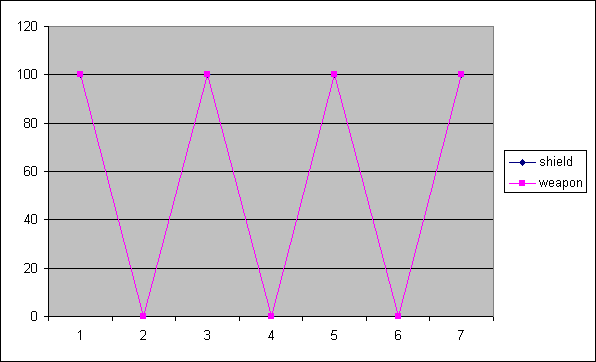
Case 1: shield and weapon frequencies are in perfect match. Shields stop weapons completely

Case 2: shields and weapons are in complete mismatch. Weapons pass throught shields unhindered

Case 3: most common case before advent of regenerative shields. Shields and weapons are in partial match only. Shields stop most of damage but rest passes throught.
Problem is with photon torpedoes - bleedthrought damage from "photons" should be severe if my theory is right, but it rarely seems to be greater than that of phasers. However, nature of shields might have something with that.
Shield strength from "Relics"
Enterprise-D held orbit in Cromosphere. Altitude was 150 000 kilometers (presumably from surface of star). Temperature of corona is more than 10e6 K (1 000 000 to 6 000 000 K at density of about 100 million to 1 billion particles.
"... the coronal cloud has a thermal energy of 10e51 ergs at 20 kpc..."
1 erg is 10e(-7) J. 1 kpc is 10e19 m or 10e17 km. At 150 000 km energy should be 3.9 x 10e46 J or 9.32 x 10e27 Gt over area of 8.98 x 10e18 square meters. Surface area of E-D shields is 321 700 m^2 when seen from side. Resulting absorbed energy is bit too high (1.397x10e33 J), so I guess I'll have to check all of calculations later.
(unfinished)
Shield geometry
Shields can have oval and hull-hugging shape.
Other uses
Photon torpedoes are also shielded; not only they can pass throught shields by using right frequency - only possible if torpedoes themselves are shielded - and sit in core of star for several minutes or dig in planet's crust - but we saw ship in TOS episode "Journey to Babel" which increased strength of its shields enough to make shields glow just like photon torpedo.
NOTES
In TOS episode "The Changeling" Spick reports that "We just absorbed equivalent of 90 of our photon torpedoes. Shields can withstand 3 more such attacks. Fourth attack will shatter shields completely." So TOS shields can absorb equivalent of 360 photon torpedoes of that era.
Shield pages on my site:
http://picard578.hostoi.com/startrek-vs-starwars/star_trek/space/starship_tactical_systems/shields/deflector_shields.html
http://picard578.hostoi.com/startrek-vs-starwars/star_trek/space/starship_tactical_systems/shields/regenerative_shields.html
NOTES
In TOS episode "The Changeling" Spick reports that "We just absorbed equivalent of 90 of our photon torpedoes. Shields can withstand 3 more such attacks. Fourth attack will shatter shields completely." So TOS shields can absorb equivalent of 360 photon torpedoes of that era.
Shield pages on my site:
http://picard578.hostoi.com/startrek-vs-starwars/star_trek/space/starship_tactical_systems/shields/deflector_shields.html
http://picard578.hostoi.com/startrek-vs-starwars/star_trek/space/starship_tactical_systems/shields/regenerative_shields.html
četvrtak, 26. kolovoza 2010.
Phaser rifles
Dominion-war era rifle (Type III A)


Type 3a is my designation for version of rifle we see in Dominion War. Head of rifle is then-standard Starfleet "hair dryer" design, and has flip-up scope which is probably more of miniature viewscreen than traditional scope (if it was traditional scope it would be completely useless, not only due to design but also due to flashlight attached in front of it). Bulky, resillient, with ability fire both single beams (in "normal" and "widebeam" setting) and pulses (latter are usually fired in bursts), 16 power settings, gyrostabilized, but too complex for battlefield usage (as Kira commented), it is survivable tool and weapon in one, just like standard hand phaser. It does not seem to be more powerful than hand phaser, but probably has greater power storage. Range is presumably larger than that of standard phaser; however I can't remember any examples when it was actually shown.
Type III B (First Contact)
This one is my personal favourite along with "Nemesis" rifle. Not only it is ergonomically superior to type A, but also looks like it can take beating and still shoot, unlike type D. We only saw it fire pulses, which could indicate that it is intended primarly for CQC (Close Quarters Combat - in buildings, corridors like these on staships etc), where rapid-fire ability and simplicity are more important than range and precision. Equipped with scope and flashlight.
Type III C (First Contact, Insurrection)

This one seems to be further development of Type III B, possibly as more versatile and multi-role battlefield weapon - that is implied by fact that this type, while it never shown off-axis or widebeam setting like Type III A, and it can be safely assumed it does not have that ability, it was shown to fire both pulses and beams - hence my theory that Type III B was primarly for usage in close quarters combat which is standard when starship gets boarded, while this one is more multi-scenario weapon. In Insurrection, Picard, Worf and Data blasted hole throught cave wall - that might mean that this rifle lacks disintegration setting (indeed, I would not be surprised if it only has "stun" and "kill" settings, as opposed to 16 settings on Type III a). However, Data was holding standard hand phaser in that scene so better explanation would be that they just did not have time/will to change setting before firing.
Type III D (Nemesis)


Rifle seen in "Nemesis" is visually extremely similar to type C, with more powerful flashlight and new targeting sight, behind and above flashlight. It fired pulses in faster succession and pulses themselves were smaller than those in First Contact and Insurrection. For all intents and purposes, it seems to be just shipboard version of Type III C (something similar to M4 when compared to M16 - M4 is just smaller, carbine version of M16 optimized for CQC), possibly replacing Type III B.
Type III B EVA

EVA version of Type III B, optimised for EVA combat (in situations that require EVA suit and its fat gloves). It has forward grip, much like M4, for faster aiming, and trigger guard is removed. Remainder of rifle is also redesigned, with more rounded barrell and different rifle butt when compared to standard Type B.
Size of Imperial Fleet
"No, the entire Imperial fleet couldn't have done this. It would take a thousand ships massing a lot more firepower than has ever existed."
That Solo's quote could imply that entire Imperial Starfleet is less than 1000 capital ships strong. Given that single fleet protecting Death Star had 1 Super Star Destroyer (SSD) and ~20 Star Destroyers, we can assume 47 Super Star Destroyers and 940 Star Destroyers.
Solo might not be military man, but he is resident of that place and time, and we should not assume he is wrong. I already know that Croatian fleet has only 5 missile boats, with 3 of these being home-produced, even without checking Wikipedia (written on 28. 11. 2010.).
There is also one quote from RotS novelization:
"With little else to lose, Ackbar decided to try Calrissian's strategy. In the next minutes, dozens of Rebel Cruisers moved in astronomically close to the Imperial Star Destroyers—and the colossal antagonists began blasting away at each other, like tanks at twenty paces, while hundreds of tiny fighters raced across their surfaces, zipping between laser bolts as they chased around the massive hulls."
"Dozen" means thirty. So we have several hundred Rebel cruiser and presumably similar number of ISD's. That gives Imperial fleet size of 5 SSD's and 1000 ISD's. However, movie is still higher canon.
Way better analysis on my site.
That Solo's quote could imply that entire Imperial Starfleet is less than 1000 capital ships strong. Given that single fleet protecting Death Star had 1 Super Star Destroyer (SSD) and ~20 Star Destroyers, we can assume 47 Super Star Destroyers and 940 Star Destroyers.
Solo might not be military man, but he is resident of that place and time, and we should not assume he is wrong. I already know that Croatian fleet has only 5 missile boats, with 3 of these being home-produced, even without checking Wikipedia (written on 28. 11. 2010.).
There is also one quote from RotS novelization:
"With little else to lose, Ackbar decided to try Calrissian's strategy. In the next minutes, dozens of Rebel Cruisers moved in astronomically close to the Imperial Star Destroyers—and the colossal antagonists began blasting away at each other, like tanks at twenty paces, while hundreds of tiny fighters raced across their surfaces, zipping between laser bolts as they chased around the massive hulls."
"Dozen" means thirty. So we have several hundred Rebel cruiser and presumably similar number of ISD's. That gives Imperial fleet size of 5 SSD's and 1000 ISD's. However, movie is still higher canon.
Way better analysis on my site.
srijeda, 25. kolovoza 2010.
Planetary defences
Planetary Shields
Star Wars planetary shields
Star Wars does have theatre shields, like one protecting Rebel base on Hoth in TESB, but there is no evidence of planetary shields in canon. Some say that dialogue supports planetary shield on Hoth, but there are some problems with planetary shield:
1) If shield was stopping orbital bombardment, and ships could pass through it, Empire just needed to send several bomber squadrons and/or Star Destroyers to bombard Rebel base from under the shield. Also, there would be no need to drop shield to allow escaping transports to pass throught shield.
2) If such shield can stop ships, how Empire landed troops on planet? Shield was clearly still operable by time General Veers ordered walkers to shoot at shield generator.
Also, let's get closer look at dialogue:
VEERS: My lord, the fleet has moves out of light-speed. Com-Scan has detected an energy field protecting an area around the sixth planet of the Hoth system. The field is strong enough to deflect any bombardment.
Later:
VADER: Make ready to land out troops beyond the energy shield and deploy the fleet so that nothing gets off that system. You are in command now, Admiral Piett.
So, whatever that "energy field" was, it was not planetary shield.
As for RotS novelization, it does support planetary shield but that goes against higher canon (movies). For details, see here.
CONCLUSION: We have absolutely no evidence of planetary shields in Star Wars canon.
Star trek planetary shields
Planetary shields as existed in Trek as far back as TOS. The first example being the shield protecting the Tantalus penal colony in "Dagger of the Mind" that at the very least blocked transporters. The second and more formidable one appears in "Whom Gods Destroy" which was projected from the Elba II Asylum dome and was powerful enough to resist the firepower of the E-1701's main phaser banks even at it's weakest point on the side of the planet opposite the asylum.
This is dialogue from "Whom Gods Destroy":
SCOTTY: "Sensor readings."
SULU: "Forcefield is weakest on far side of the planet."
Nothng conclusive is mentioned throughout the movies, TNG and DS9, though in episodes like "Gambit, Part 1", there is at least theater coverage shielding for a small scientific outpost along with phasers and possibly photon torpeodes. However VOY's "Year of Hell, Part 2" implies strongly that even relatively primitive starfaring civilizations ought to have them, and "Nightingale" actually shows one in operation protecting the Kraylor homeworld from bombardment and invasion by the Annari fleet blockading it.
Also, episode "The Chase" from TNG shows that one Vor'Cha class Attack Cruiser is able to destroy life on entire world, down to last mollecule, by using chain reaction - that means that full planetary shields must be in use, beacouse theatre shields would be useless. Also, in TNG episode "Chain of Command", main problem with Cardassian bioweapon-delivery system was not that it can deliver microbes over great distance without carrying missile or ship, but rather that it can do so without target realizing it (and raising shields). "Die is Cast" also seems to confirm existence of planetary shields:
TAIN: "...and begin massive bombardment..."
GARAK: "Well, that should more than take care about the Founders."
TAIN: "Yes, unless Founders have some planetary defences we don't know about" (emphasis mine). Within context, it is clear that he was talking about planetary shields.
Also, Breen attack on San Francisco caused only slight damage, most likely bleedthrought from planetary shield.
Active defences
Star Wars
Hoth ion cannon
Rebel Ion canon on Hoth seems to be able to not only completely disable Star Destroyer, but also to bypass/defeat shields. One way or another, it is clear that Imperial and Star Wars shields in general are vulnerable to disruption or penetration by electronic shots, since shields did not seem to affect ion pulses fired by canon, and Star Destroyer was left completely powerless and adrift.
Star Trek
We don't knaw what kind of planetary defences Federation has, but we can guess when looking Federation's neighbours.
Cardassians deployed weapon platforms. These seemed to be fairly recent development from their alliance with Dominion, but again Federation is more advanced but more peace-loving state. Better guess would be orbital stations - we seen some Starbases, like Spacedock (in orbit around Earth) and Starbase 375. Also mentioned are "antiquated" PDS on Betazed, that were inadequate in stopping Dominion attack without fleet support. However, we never see PDS in action, probably due to budgetary reasons.
These might be planetary-based phaser emitters and torpedo launchers, since we know that Cardassians have designed special type of disruptor for planetary defence and according to non-canon technical manuals, phasers used by Sovereign and Prometheus class starships were originally used for planetary defence.
Star Trek active planetary defences
Star Trek passive planetary defences
Star Wars active planetary defences
Star Wars passive planetary defences
Star Wars planetary shields
Star Wars does have theatre shields, like one protecting Rebel base on Hoth in TESB, but there is no evidence of planetary shields in canon. Some say that dialogue supports planetary shield on Hoth, but there are some problems with planetary shield:
1) If shield was stopping orbital bombardment, and ships could pass through it, Empire just needed to send several bomber squadrons and/or Star Destroyers to bombard Rebel base from under the shield. Also, there would be no need to drop shield to allow escaping transports to pass throught shield.
2) If such shield can stop ships, how Empire landed troops on planet? Shield was clearly still operable by time General Veers ordered walkers to shoot at shield generator.
Also, let's get closer look at dialogue:
VEERS: My lord, the fleet has moves out of light-speed. Com-Scan has detected an energy field protecting an area around the sixth planet of the Hoth system. The field is strong enough to deflect any bombardment.
Later:
VADER: Make ready to land out troops beyond the energy shield and deploy the fleet so that nothing gets off that system. You are in command now, Admiral Piett.
So, whatever that "energy field" was, it was not planetary shield.
As for RotS novelization, it does support planetary shield but that goes against higher canon (movies). For details, see here.
CONCLUSION: We have absolutely no evidence of planetary shields in Star Wars canon.
Star trek planetary shields
Planetary shields as existed in Trek as far back as TOS. The first example being the shield protecting the Tantalus penal colony in "Dagger of the Mind" that at the very least blocked transporters. The second and more formidable one appears in "Whom Gods Destroy" which was projected from the Elba II Asylum dome and was powerful enough to resist the firepower of the E-1701's main phaser banks even at it's weakest point on the side of the planet opposite the asylum.
This is dialogue from "Whom Gods Destroy":
SCOTTY: "Sensor readings."
SULU: "Forcefield is weakest on far side of the planet."
Nothng conclusive is mentioned throughout the movies, TNG and DS9, though in episodes like "Gambit, Part 1", there is at least theater coverage shielding for a small scientific outpost along with phasers and possibly photon torpeodes. However VOY's "Year of Hell, Part 2" implies strongly that even relatively primitive starfaring civilizations ought to have them, and "Nightingale" actually shows one in operation protecting the Kraylor homeworld from bombardment and invasion by the Annari fleet blockading it.
Also, episode "The Chase" from TNG shows that one Vor'Cha class Attack Cruiser is able to destroy life on entire world, down to last mollecule, by using chain reaction - that means that full planetary shields must be in use, beacouse theatre shields would be useless. Also, in TNG episode "Chain of Command", main problem with Cardassian bioweapon-delivery system was not that it can deliver microbes over great distance without carrying missile or ship, but rather that it can do so without target realizing it (and raising shields). "Die is Cast" also seems to confirm existence of planetary shields:
TAIN: "...and begin massive bombardment..."
GARAK: "Well, that should more than take care about the Founders."
TAIN: "Yes, unless Founders have some planetary defences we don't know about" (emphasis mine). Within context, it is clear that he was talking about planetary shields.
Also, Breen attack on San Francisco caused only slight damage, most likely bleedthrought from planetary shield.
Active defences
Star Wars
Hoth ion cannon
Rebel Ion canon on Hoth seems to be able to not only completely disable Star Destroyer, but also to bypass/defeat shields. One way or another, it is clear that Imperial and Star Wars shields in general are vulnerable to disruption or penetration by electronic shots, since shields did not seem to affect ion pulses fired by canon, and Star Destroyer was left completely powerless and adrift.
Star Trek
We don't knaw what kind of planetary defences Federation has, but we can guess when looking Federation's neighbours.
Cardassians deployed weapon platforms. These seemed to be fairly recent development from their alliance with Dominion, but again Federation is more advanced but more peace-loving state. Better guess would be orbital stations - we seen some Starbases, like Spacedock (in orbit around Earth) and Starbase 375. Also mentioned are "antiquated" PDS on Betazed, that were inadequate in stopping Dominion attack without fleet support. However, we never see PDS in action, probably due to budgetary reasons.
These might be planetary-based phaser emitters and torpedo launchers, since we know that Cardassians have designed special type of disruptor for planetary defence and according to non-canon technical manuals, phasers used by Sovereign and Prometheus class starships were originally used for planetary defence.
Star Trek active planetary defences
Star Trek passive planetary defences
Star Wars active planetary defences
Star Wars passive planetary defences
Size of Starfleet and other fleets
There are possibly 700 Starbases so 7 000-ship fleet is reasonable for Starfleet to maintain. Possibly even larger; however, we know that runabouts are included in NCC sequence and there is no way of knowing how large number of runabouts is when compared to capital ships, and I will do numbering for capital ships only. Given that by DS9 ship registries are in 70 000's, fleet of 30 - 50 000 ships with 7 000 to 30 000 being capital ships is reasonable.
In "The Dogs of War" Romulan commander is worried about losing "thousands of ships" in final assault on Dominion lines. But we have no clear figure.
Galaxy class: 120 (starting value)
EDIT: I ended my analysis, but Galaxy class appears too often, giving too low number of 682 ships in Starfleet. However, given that Galaxies will always be in middle of fight, just like Defiant, it is not very unreasonable to assume that actual percentage of GCS in fleet is lower. So I will assume that only 1/10 of fleet is shown, and only 12 Galaxy class ships within that part of fleet. So we have 6820 capital ships for Starfleet with 34 000 high limit.
I got these numbers from DS9 analysis:
120 Galaxy class starships
560 Excelsior class starships
610 Miranda class starships
90 Defiant class starships
180 Akira class starships
100 Saber class starships
90 Nebula class starships
However, other classes' appearances are less clear. Also, these numbers might be only ships that participated in Dominion war; given wierd warp speeds, Starfleet might or might not be able to get all ships to front lines. If entire fleet did participated in war, we have 6820 capital ships; if it did not, then number is around 34 000 ships.
I will now go with fleet sizes for all powers:
Lower value:
Starfleet: 6820 ships
Klingon fleet: 5456 to 6138 ships (2728 to 3069 BoP; 1705 to 1918 Vor'Cha; 682 to 767 K't'inga; 341 to 384 Negh'var).
Cardassian fleet: 1705 ships (1500 Galor and 205 Keldon class)
Romulan fleet: 974 D'deridex class warbirds
Breen fleet: 568 ships
Higher value:
Starfleet: 34 000 ships
Klingon fleet: 27 200 to 30 600 ships (13 600 to 15 300 BoP; 8500 to 9561 Vor'Cha; 3400 to 3824 K't'inga; 1700 to 1915 Negh'var)
Cardassian fleet: 8500 ships (7478 Galor and 1022 Keldon class)
Romulan fleet: 4856 D'deridex class warbirds
Breen fleet: 2832 ships
Additional analysis
There might be 1000 Excelsior and 300 Sabers in Starfleet. That means up to 2.5 times larger number, which gives 120 Galaxies, 1000 Excelsiors, 300 Sabers, 1200 Miranda, 180 Defiant, 405 Akira, 220 Nebula class starships, ending with 17 050 capital ships in Starfleet.
So:
Starfleet: 17 050 ships
KDF: 13 600 to 15 300 ships
Cardassian Guard: 4 250 ships
Romulan fleet: 2428 warbirds
Breen fleet: 1416 ships
UPDATE: It might be possible to get starship number by using number of starbases as basis. Here we have screenshot showing 16 ships (1 Defiant class, 2 Galaxy class, 5 Excelsior class, 4 Miranda class and 4 Centurion class ships) nearby. Highest starbase number we hear about is 718. If we use ratio of 20 ships for one starbase we get 14 360 ships (20 ships were what Captain Picard succeded in rallying for Klingon Civil War). If we use 16:1 ratio, we get 11 500 ships. However, not all starbases are space stations, so we can end up with 8 000 to 10 000 ships in Starfleet.
In "BoBW" we know that 39 ships will be replaced in "under a year". "Under a year" might be 6 months to 364 days. If we have 4 ships per month, with ships having lifespan of around 100 years, we get a fleet of almost 5000 ships for peacetime production. Given that Federation already fought several wars and probably boosted ship production during that time (possibly explaining large amount of Excelsiors) 8 000 ships is at least possible.
Starfleet size analysis on my site
In "The Dogs of War" Romulan commander is worried about losing "thousands of ships" in final assault on Dominion lines. But we have no clear figure.
Galaxy class: 120 (starting value)
EDIT: I ended my analysis, but Galaxy class appears too often, giving too low number of 682 ships in Starfleet. However, given that Galaxies will always be in middle of fight, just like Defiant, it is not very unreasonable to assume that actual percentage of GCS in fleet is lower. So I will assume that only 1/10 of fleet is shown, and only 12 Galaxy class ships within that part of fleet. So we have 6820 capital ships for Starfleet with 34 000 high limit.
I got these numbers from DS9 analysis:
120 Galaxy class starships
560 Excelsior class starships
610 Miranda class starships
90 Defiant class starships
180 Akira class starships
100 Saber class starships
90 Nebula class starships
However, other classes' appearances are less clear. Also, these numbers might be only ships that participated in Dominion war; given wierd warp speeds, Starfleet might or might not be able to get all ships to front lines. If entire fleet did participated in war, we have 6820 capital ships; if it did not, then number is around 34 000 ships.
I will now go with fleet sizes for all powers:
Lower value:
Starfleet: 6820 ships
Klingon fleet: 5456 to 6138 ships (2728 to 3069 BoP; 1705 to 1918 Vor'Cha; 682 to 767 K't'inga; 341 to 384 Negh'var).
Cardassian fleet: 1705 ships (1500 Galor and 205 Keldon class)
Romulan fleet: 974 D'deridex class warbirds
Breen fleet: 568 ships
Higher value:
Starfleet: 34 000 ships
Klingon fleet: 27 200 to 30 600 ships (13 600 to 15 300 BoP; 8500 to 9561 Vor'Cha; 3400 to 3824 K't'inga; 1700 to 1915 Negh'var)
Cardassian fleet: 8500 ships (7478 Galor and 1022 Keldon class)
Romulan fleet: 4856 D'deridex class warbirds
Breen fleet: 2832 ships
Additional analysis
There might be 1000 Excelsior and 300 Sabers in Starfleet. That means up to 2.5 times larger number, which gives 120 Galaxies, 1000 Excelsiors, 300 Sabers, 1200 Miranda, 180 Defiant, 405 Akira, 220 Nebula class starships, ending with 17 050 capital ships in Starfleet.
So:
Starfleet: 17 050 ships
KDF: 13 600 to 15 300 ships
Cardassian Guard: 4 250 ships
Romulan fleet: 2428 warbirds
Breen fleet: 1416 ships
UPDATE: It might be possible to get starship number by using number of starbases as basis. Here we have screenshot showing 16 ships (1 Defiant class, 2 Galaxy class, 5 Excelsior class, 4 Miranda class and 4 Centurion class ships) nearby. Highest starbase number we hear about is 718. If we use ratio of 20 ships for one starbase we get 14 360 ships (20 ships were what Captain Picard succeded in rallying for Klingon Civil War). If we use 16:1 ratio, we get 11 500 ships. However, not all starbases are space stations, so we can end up with 8 000 to 10 000 ships in Starfleet.

In "BoBW" we know that 39 ships will be replaced in "under a year". "Under a year" might be 6 months to 364 days. If we have 4 ships per month, with ships having lifespan of around 100 years, we get a fleet of almost 5000 ships for peacetime production. Given that Federation already fought several wars and probably boosted ship production during that time (possibly explaining large amount of Excelsiors) 8 000 ships is at least possible.
Starfleet size analysis on my site
Pretplati se na:
Postovi (Atom)